How to Choose Educational Apps That Actually Teach
Not all kids' apps are educational. What makes an app effective for preschoolers: active learning, curriculum alignment, adaptive difficulty, and red flags.
QuizKin Team
Published 17 April 2026
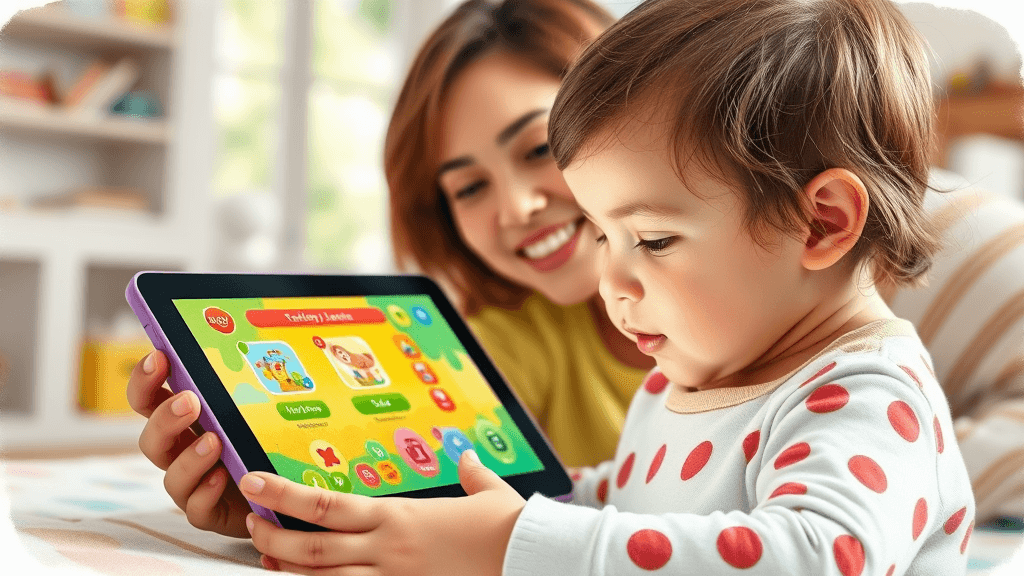
Let us address the elephant in the room: you feel guilty about giving your child a tablet. You have read the articles about screen time damaging young brains, seen the headlines about digital addiction, and heard other parents proudly declare their homes are "screen-free." And yet, here you are, searching for information about educational apps for your preschooler.
TL;DR: Not all kids' apps are educational. What makes an app effective for preschoolers: active learning, curriculum alignment, adaptive difficulty, and red flags.
Here is the truth: the screen time conversation is more nuanced than the headlines suggest. Not all screen time is created equal, the research is less alarming than most media coverage implies, and for many families, well-chosen educational apps are a practical and effective part of their child's learning routine. This guide separates fear from evidence and gives you a practical framework for making screen time work for your family.
What the Research Actually Says
The AAP Guidelines
The American Academy of Pediatrics (AAP) is the most-cited authority on children's screen time. Here are their current recommendations:
- Under 18 months: Avoid screen time (except video calling)
- 18-24 months: Only high-quality programming, watched with a parent
- 2-5 years: No more than 1 hour per day of high-quality programming
- 6 and older: Consistent limits that ensure screen time does not displace sleep, physical activity, and social interaction
These are sensible guidelines, but note what they emphasise: quality and displacement. The concern is not that screens emit brain-damaging radiation. The concern is that excessive, low-quality screen time takes time away from other important activities — outdoor play, reading, conversation, and sleep.
The Nuance the Headlines Miss
Most of the alarming research about screen time is about passive consumption — children watching videos for hours, scrolling endlessly, or being parked in front of a screen while parents are busy. This type of screen time is genuinely associated with:
- Reduced attention spans
- Delayed language development (when it displaces conversation)
- Disrupted sleep (especially in the hour before bedtime)
- Reduced physical activity
However, research on active, educational screen time tells a different story. A 2020 meta-analysis in JAMA Pediatrics found that educational programming and co-viewing are associated with stronger language skills in young children. Separately, a meta-analysis of 36 studies on educational apps found they can improve early literacy and numeracy skills in preschoolers (effect size +0.31 SD). The key factors were:
- The app required active participation (not passive watching)
- The content was curriculum-aligned with specific learning goals
- The app adapted to the child's level (not one-size-fits-all)
- Sessions were short (10-20 minutes) and bounded (clear beginning and end)
Passive vs Active Screen Time
Understanding this distinction is the most important concept in this entire article.
Passive Screen Time
Your child is a consumer. They watch, scroll, and absorb — but they do not think, create, or make decisions.
Examples:
- Watching YouTube videos
- Watching cartoons or movies
- Scrolling through photo galleries
- Watching "unboxing" or "toy review" videos
The problem: Passive content is designed to hold attention, not build skills. Autoplay features keep children watching indefinitely. There is no learning objective, no feedback loop, and no endpoint.
Active Screen Time
Your child is a participant. They think, respond, solve problems, or create something.
Examples:
- Completing an adaptive quiz that responds to their answers
- Drawing or creating art in a digital tool
- Recording and watching themselves tell a story
- Playing a puzzle or strategy game
- Video calling a grandparent and having a conversation
The benefit: Active screen time engages the same cognitive skills as non-digital learning — attention, memory, problem-solving, pattern recognition. When the content is curriculum-aligned, it can directly build academic skills.
A Practical Test
Ask yourself: "If I turned off the screen right now, would my child notice within 10 seconds?" If yes — they are actively engaged. If they would keep sitting there for another minute before realising — they are in passive consumption mode.
What Makes an Educational App Actually Educational
The app store is full of apps that call themselves "educational" but are really entertainment products with a thin learning veneer. Here is how to tell the difference:
Signs of a Genuinely Educational App
- Clear learning objectives: The app teaches specific, named skills (letter sounds, sight words, counting) — not vague "brain training"
- Curriculum alignment: Content is based on an actual educational framework (like the MOE NEL framework) rather than made-up "levels"
- Adaptive difficulty: The app adjusts to your child's level — harder questions when they are doing well, easier ones when they struggle
- Immediate feedback: Your child knows instantly whether their answer was correct, and the app explains why
- Session boundaries: The app has natural stopping points or session limits — it does not encourage endless play
- Progress tracking: You can see what your child is learning and where they need more practice
- No manipulative design: No lootboxes, no gacha mechanics, no "watch an ad for more lives", no pressure to make in-app purchases
Red Flags
- Endless autoplay: The app moves to the next activity without any break or stopping point
- Reward-heavy, learning-light: Lots of celebrations and animations but very little actual content
- No wrong answers: Every response gets a positive reaction (this is entertainment, not education)
- Aggressive monetisation: Constant prompts to buy, subscribe, or watch ads
- Vague claims: "Makes your child smarter" or "develops creativity" without explaining how
A Framework for Productive Screen Time
Here is a practical framework that balances the benefits of educational technology with healthy limits:
1. Set Clear Time Limits
For 4-6 year olds, 20-30 minutes of quality screen time per day is a good target. Some families allow more on weekends. The exact number matters less than consistency and quality.
Implementation tip: Use a visual timer that your child can see. "When the timer runs out, screen time is over." This removes you from the role of "screen time police."
2. Screen Time Follows Physical Time
A simple rule: screen time happens only after physical activity. Morning play at the playground, then a 20-minute quiz session. This ensures screens do not displace movement.
3. No Screens in the Last Hour Before Bed
Blue light from screens suppresses melatonin production and can delay sleep onset. Regardless of content quality, all screens should go off at least 60 minutes before bedtime.
4. Sit With Your Child (Sometimes)
You do not need to supervise every minute of screen time, but sitting with your child regularly — asking what they are learning, celebrating correct answers, discussing tricky questions — transforms screen time from solitary consumption into shared learning.
5. Use the Right App for the Right Purpose
Not every screen moment needs to be "educational." It is fine for your child to watch a cartoon for 20 minutes while you cook dinner. The goal is not to eliminate passive screen time entirely, but to ensure it does not become the dominant type.
A reasonable weekly balance might look like:
- 60% active/educational: Adaptive quizzes, creative tools, interactive books
- 30% passive/entertainment: Age-appropriate cartoons, family movies
- 10% social: Video calls with family members
6. Rotate and Curate
Keep 2-3 high-quality apps available and rotate others. Too many apps leads to shallow engagement — your child switches constantly without going deep enough to learn.
Addressing Parent Guilt
If you use screen time as part of your child's routine, you may encounter two sources of guilt:
Guilt source 1: "I am being lazy." Using a tablet to occupy your child while you cook dinner, work, or simply rest is not laziness. It is practical parenting. The question is not whether your child has screen time, but whether their overall day includes enough physical activity, conversation, reading, and sleep.
Guilt source 2: "Other parents do not allow any screen time." No, they just do not tell you about it. Survey data from Common Sense Media shows that 97% of children aged 0-8 in the US have access to a smartphone at home, and the vast majority use screens regularly. The families who claim zero screen time are a small minority, and their approach is not inherently superior — it is just different.
The evidence-based position: Moderate screen time (30-60 minutes per day) within a balanced routine — plenty of outdoor play, daily reading, adequate sleep, and regular conversation — is not harmful to your child's development. In fact, when the screen time is high-quality and educational, it can actively benefit learning.
How QuizKin Approaches Screen Time
QuizKin is designed with the research on productive screen time built into its architecture:
- Active, not passive: Every quiz requires your child to think and respond. There is no autoplay, no video content, no passive consumption
- Curriculum-aligned: All content follows the MOE NEL framework for K1-K2
- Adaptive difficulty: Questions automatically adjust to your child's level
- Short sessions: A typical quiz session is 5-10 minutes — designed to fit within healthy screen time limits
- Session boundaries: Each quiz has a clear beginning, middle, and end with a summary screen
- No manipulative design: No ads, no lootboxes, no "watch a video for more stars"
- Progress tracking: The parent dashboard shows exactly what your child is learning, which topics are strong, and which need more practice
- Audio support: Questions are read aloud by a real teacher voice, so your child practises listening skills alongside reading
The goal is not to maximise time on app. It is to make the 10-15 minutes your child does spend on QuizKin as educationally effective as possible.
Summary
Screen time is not inherently good or bad — it is a tool. Like any tool, its value depends on how you use it. Passive, unlimited screen time with low-quality content is genuinely harmful. Active, bounded screen time with high-quality educational content is genuinely helpful. Most families will use a mix of both, and that is completely fine.
The best approach is not zero screen time. It is intentional screen time: choose quality apps, set clear limits, ensure screens do not displace sleep and outdoor play, and let go of the guilt. Your child's development depends on the overall pattern of their day, not on whether they spent 20 minutes on a phonics app.
Sources
- Media and Children — American Academy of Pediatrics (AAP)
- Media and Young Minds — AAP Policy Statement, Pediatrics, 2016
- Associations Between Screen Use and Child Language Skills: A Systematic Review and Meta-analysis — Madigan et al., JAMA Pediatrics, 2020
- Measures Matter: A Meta-Analysis of the Effects of Educational Apps on Preschool to Grade 3 Children's Literacy and Math Skills — Kim et al., AERA Open, 2021
- The Common Sense Census: Media Use by Kids Age Zero to Eight, 2020 — Common Sense Media
Looking for more? Check out find a tutor for free on TuitionLah.
Exploring parenthood in Singapore? Visit ParentLah for practical tips on raising kids in Singapore.
Practise what you've read with QuizKin
Adaptive quizzes covering phonics, sight words, numbers, and more — aligned with the Singapore MOE curriculum. Free for one child.
Frequently Asked Questions
The American Academy of Pediatrics (AAP) recommends no more than 1 hour of screen time per day for children aged 2-5. For children aged 6 and older, the recommendation shifts to 'consistent limits' with an emphasis on ensuring screen time does not displace sleep, physical activity, and face-to-face interaction. The quality of screen time matters more than the exact duration.
No. Research distinguishes between passive screen time (watching videos, scrolling) and active screen time (creating, solving problems, interacting meaningfully with content). Active screen time — where the child thinks, responds, and makes decisions — is significantly less harmful and can be genuinely educational. Passive consumption is associated with the negative outcomes most studies warn about.
An effective educational app has clear learning objectives aligned with a curriculum, requires active participation (not just tapping), adapts to the child's level, provides immediate feedback, limits session length, and avoids manipulative design patterns like lootboxes or endless autoplay. Look for apps that teach specific skills (phonics, numeracy) rather than vaguely branded 'educational' entertainment.
No. Parent guilt about screen time is often driven by fear-based media coverage rather than nuanced research. The research shows that moderate, high-quality screen time within a balanced daily routine does not harm development. What matters is the overall pattern: children who have plenty of outdoor play, face-to-face interaction, and adequate sleep are not harmed by 30-60 minutes of quality screen time.
For preschoolers, well-designed educational apps can be as effective as or more effective than formal tuition for building foundational skills like phonics and numeracy. The key advantages of apps are consistent practice, immediate feedback, and adaptive difficulty — things that are difficult to achieve in a group class. However, apps cannot replace human interaction, creative play, or the social learning that happens in a classroom.
Ready to make learning fun?
QuizKin turns screen time into learning time with adaptive quizzes built for K1-K2 kids in Singapore. Free to start.
Related Articles
Screen Time Limits for Preschoolers: WHO, AAP & HPB (2026)
How much screen time for a 4-6 year old? WHO, AAP, and Singapore HPB guidelines for preschoolers, plus practical tips to set and enforce healthy limits.
Best Educational Apps for 4-Year-Olds in Singapore (2026)
Compare the best educational apps for preschoolers in Singapore. Reviews of QuizKin, Khan Academy Kids, Duolingo ABC and more, with MOE alignment focus.

Screen Time Rules for Preschoolers: Singapore Parents' Guide to Healthy Limits
Practical guide to managing screen time for preschoolers in Singapore. Evidence-based rules, MOE recommendations, and tips for balancing learning apps with offline play.