Complete Guide to MOE's NEL Framework for Parents
Plain-English guide to Singapore's MOE NEL framework. What your K1-K2 child learns, the 6 learning areas, and how to support their development at home.
QuizKin Team
Published 17 April 2026
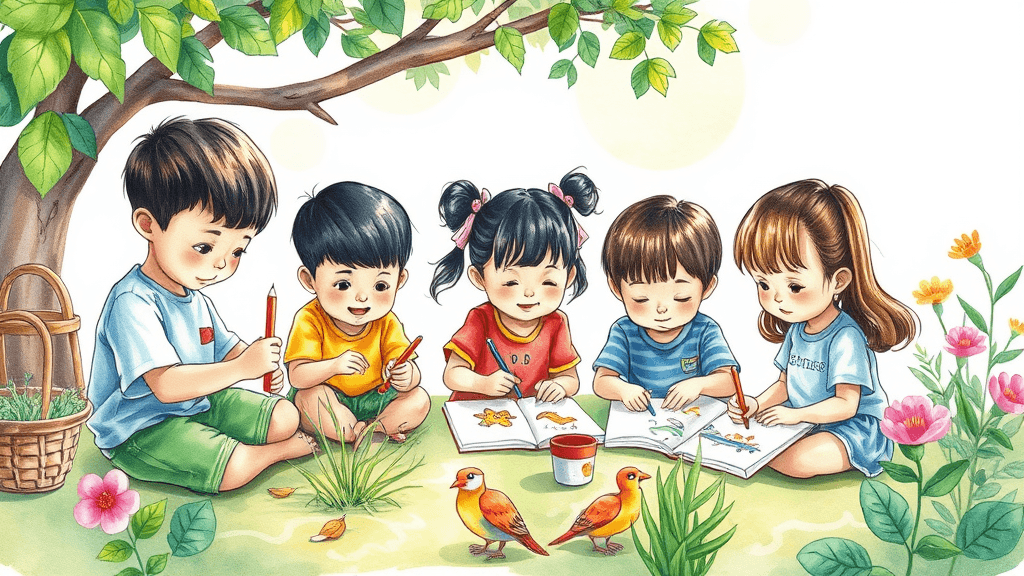
If your child is in kindergarten in Singapore, their school almost certainly follows the MOE Nurturing Early Learners (NEL) framework. But most parents have never actually read it. This guide breaks down the NEL framework in plain English so you understand exactly what your child is learning, why it matters, and how you can support them at home.
TL;DR: Plain-English guide to Singapore's MOE NEL framework. What your K1-K2 child learns, the 6 learning areas, and how to support their development at home.
What Is the NEL Framework?
The Nurturing Early Learners (NEL) framework is Singapore's national curriculum guide for pre-school education. Published by the Ministry of Education, it sets out what children aged 4 to 6 should learn and how teachers should teach them.
The framework is not a rigid syllabus with fixed lessons. Instead, it provides a set of learning goals, teaching principles, and suggested approaches that kindergartens use to design their own programmes. Think of it as the blueprint that every kindergarten builds on.
Who Uses It?
The NEL framework guides virtually all kindergartens in Singapore, including:
- MOE Kindergartens (MK) — government-run kindergartens inside primary schools
- PAP Community Foundation (PCF) Sparkletots centres
- NTUC My First Skool centres
- Most private kindergartens — including well-known chains like Busy Bees, Pat's Schoolhouse, and MindChamps
While private kindergartens are not legally required to follow the NEL framework, the vast majority do because it aligns with what Primary 1 expects.
The 6 Learning Areas
The NEL framework organises learning into 6 broad areas. These are not separate "subjects" — in practice, good kindergarten lessons integrate multiple areas at once. Here is what each area covers and what your child should be able to do by the end of K2.
1. Aesthetics and Creative Expression
This is not just "art class." It covers all forms of creative expression:
- Visual arts: Drawing, painting, collage, sculpting with playdough
- Music: Singing, rhythm, playing simple instruments
- Movement and dance: Expressive movement, creative dance
- Dramatic play: Role-playing, pretend play, storytelling through action
By the end of K2, your child should be able to:
- Express ideas through drawing and other art forms
- Participate in group music and movement activities
- Engage in imaginative play with peers
How to support this at home: Provide art materials (paper, crayons, paint, playdough). Sing together. Encourage pretend play — let your child run a "restaurant" or "clinic" at home.
2. Discovery of the World
This area builds curiosity about the natural and human-made world:
- Nature and the living world: Plants, animals, weather, seasons
- People and places: Community, family, Singapore's culture and heritage
- Science exploration: Simple experiments, cause and effect, observation skills
By the end of K2, your child should be able to:
- Ask questions about things they observe
- Describe similarities and differences between objects
- Talk about their family, school, and neighbourhood
How to support this at home: Visit parks, gardens, and museums. Ask open-ended questions: "Why do you think the leaves fell?" Encourage your child to observe and describe what they see.
3. Language and Literacy
This is often the area parents focus on most. It covers both English and Mother Tongue languages.
English language and literacy includes:
- Listening and speaking: Following multi-step instructions, recounting experiences, participating in conversations
- Reading readiness: Letter recognition (all 26 uppercase and lowercase), letter-sound relationships (phonics), sight words, understanding of print concepts (reading left to right, top to bottom)
- Writing readiness: Writing their own name, forming letters, drawing to communicate ideas
By the end of K2, your child should be able to:
- Recognise all 26 letters in both uppercase and lowercase
- Know the sounds that letters make (phonics)
- Read common sight words (e.g., "the", "is", "and", "can")
- Write their name and some simple words
- Listen to a story and answer questions about it
- Speak in complete sentences
How to support this at home: Read together every day for at least 15 minutes. Point to words as you read. Practise letter sounds (not just letter names — "sss" not "ess"). Use flashcards or apps like QuizKin that cover phonics and sight words systematically.
4. Motor Skills Development
Both fine motor (small movements) and gross motor (large movements) skills:
- Fine motor: Holding a pencil correctly, cutting with scissors, threading beads, buttoning clothes
- Gross motor: Running, jumping, climbing, balancing, throwing and catching a ball
- Health and safety: Personal hygiene, healthy eating habits, road safety awareness
By the end of K2, your child should be able to:
- Hold a pencil with a proper grip and write legibly
- Use scissors to cut along a line
- Run, hop, and balance on one foot
- Dress and undress independently
How to support this at home: Encourage outdoor play. Provide playdough, threading activities, and colouring. Teach your child to button their uniform and pack their bag.
5. Numeracy
Mathematical thinking and number sense, building foundations for Primary 1 maths:
- Number concepts: Counting up to 20, recognising numerals 0-20, understanding "more than" and "less than", simple addition and subtraction
- Patterns: Recognising and creating patterns (AB, ABC, AABB)
- Shapes and spatial awareness: Identifying 2D shapes (circle, square, triangle, rectangle), understanding position words (above, below, beside, between)
- Measurement: Comparing size, length, weight, and capacity using non-standard units
By the end of K2, your child should be able to:
- Count forwards and backwards from 1 to 20
- Recognise numerals and match them to quantities
- Solve simple addition and subtraction problems (within 10)
- Identify and name basic 2D shapes
- Recognise, describe, and extend simple patterns
How to support this at home: Count everything — stairs, apples, toy cars. Play board games that involve counting. Ask "How many more?" questions. Point out shapes in everyday life.
6. Social and Emotional Development
Often the most underappreciated area, but arguably the most important for long-term success. For a deep dive into building these skills at home, see our guide on social-emotional learning for preschoolers.
- Self-awareness: Recognising and naming their emotions, understanding their strengths
- Self-management: Waiting their turn, following rules, managing frustration
- Social awareness: Showing empathy, respecting differences
- Relationship skills: Cooperating with peers, sharing, resolving conflicts with words
- Responsible decision-making: Making choices and understanding consequences
By the end of K2, your child should be able to:
- Name their emotions and talk about what caused them
- Take turns and share with others
- Follow classroom rules without constant reminders
- Work cooperatively in a small group
- Show care and concern for others
How to support this at home: Talk about feelings openly. Model empathy. When conflicts arise between siblings, guide them to use words instead of actions. Praise effort, not just results.
The iTeach Principles
The NEL framework also defines 6 teaching principles that guide how kindergarten teachers approach their work. These spell out "iTeach":
- i — Integrated approach to learning (connecting multiple learning areas in one activity)
- T — Teachers as facilitators of learning (guiding, not lecturing)
- E — Engaging children in learning through play (play-based pedagogy)
- A — Authentic learning through quality interactions (real-world, meaningful experiences)
- C — Children as constructors of knowledge (hands-on exploration, not rote memorisation)
- h — Holistic development (developing the whole child, not just academic skills)
The key takeaway: the NEL framework is explicitly against rote learning and drill-based teaching for young children. If your kindergarten is spending most of the day on worksheets and memorisation, they may not be following the NEL framework as intended.
How the NEL Framework Connects to Primary 1
The NEL framework is designed to prepare children for a smooth transition to Primary 1. Here is how the kindergarten learning areas map to P1 subjects:
- Language and Literacy directly feeds into English Language (P1) — letter recognition, phonics, sight words, reading comprehension
- Numeracy directly feeds into Mathematics (P1) — number bonds, addition, subtraction, patterns, shapes
- Mother Tongue Language continues as a dedicated subject in primary school
- Social and Emotional Development underpins the ability to function in a structured classroom, follow instructions, and work with peers
- Motor Skills support handwriting, PE, and general independence
The MOE has been deliberate about aligning the K2 exit standards with the P1 entry expectations. If your child completes K2 at a school following the NEL framework, they should be ready for Primary 1 without extensive extra tuition.
Common Parent Questions
Is My Child Behind?
Every child develops at their own pace. The NEL framework describes goals for the end of K2, not fixed milestones at each month. Some children will master phonics early but develop numeracy skills later, or vice versa. Consistent exposure and practice matter more than hitting every milestone at the same time.
Should I Send My Child for Extra Tuition?
For most K1-K2 children, extra tuition is unnecessary if they are in a kindergarten that follows the NEL framework. The framework is designed to be sufficient preparation for Primary 1. However, if your child is struggling significantly in a specific area — particularly phonics or number sense — targeted practice at home or through educational tools can help close gaps without the pressure of formal tuition.
How Do I Know If My Kindergarten Follows the NEL Framework?
Ask your kindergarten directly. Most will reference the NEL framework in their curriculum documents or parent handbooks. MOE Kindergartens, PCF, and NTUC centres follow it by default. For private kindergartens, look for alignment with the 6 learning areas described above. For a detailed comparison of kindergarten types in Singapore, see our guide to choosing a kindergarten.
Using QuizKin to Reinforce NEL Learning
QuizKin's quiz categories are specifically aligned with the NEL framework's Language & Literacy and Numeracy learning areas:
- Phonics: All 42 letter sounds, aligned with the NEL phonics progression
- Sight Words: Common sight words that K1-K2 children are expected to recognise
- Letters: Uppercase and lowercase recognition
- Numbers: Counting, numeral recognition, and simple operations
- Shapes: 2D shape identification
- Colours: Colour recognition and naming
- Patterns: Pattern recognition and completion
The adaptive learning algorithm identifies which skills your child needs more practice on and automatically adjusts the quiz content — similar to how a good kindergarten teacher would focus on areas where your child needs more support.
Summary
The MOE NEL framework is a well-designed curriculum guide that ensures your child develops holistically across 6 key areas. It emphasises play-based learning over rote memorisation, and it is designed to prepare children for Primary 1 without the need for excessive tuition.
As a parent, the most impactful things you can do are: read with your child daily, practise letter sounds and counting through everyday activities, encourage creative play, and talk about emotions. These simple habits reinforce what your child is learning at school and build a strong foundation for primary school and beyond.
Sources
- Nurturing Early Learners (NEL) Framework — Ministry of Education, Singapore
- MOE Kindergartens (MK) — Ministry of Education, Singapore
- PCF Sparkletots Preschool — PAP Community Foundation
- My First Skool — NTUC First Campus
Looking for more? Check out find a tutor for free on TuitionLah.
Exploring parenthood in Singapore? Visit ParentLah for practical tips on raising kids in Singapore.
Practise what you've read with QuizKin
Adaptive quizzes covering phonics, sight words, numbers, and more — aligned with the Singapore MOE curriculum. Free for one child.
Frequently Asked Questions
The Nurturing Early Learners (NEL) framework is Singapore's national curriculum guide for kindergartens. Published by the Ministry of Education, it defines what children aged 4 to 6 should learn across 6 key areas: aesthetics and creative expression, discovery of the world, language and literacy, motor skills development, numeracy, and social and emotional development.
While private kindergartens are not legally required to follow the NEL framework, the vast majority of Singapore kindergartens — including MOE Kindergartens, PAP Community Foundation (PCF), NTUC My First Skool, and most private operators — align their curricula with it. It is the national standard and the basis for Primary 1 readiness.
The NEL framework covers children in Nursery (age 4), Kindergarten 1 (age 5), and Kindergarten 2 (age 6). It is designed to prepare children for Primary 1 entry at age 7.
Read with your child daily for at least 15 minutes, practise letter sounds and sight words through play, count objects during everyday activities like grocery shopping, encourage drawing and creative play, and talk about emotions to build social-emotional skills. Apps like QuizKin can reinforce phonics, numeracy, and literacy skills aligned with the NEL framework.
Yes. QuizKin's quiz categories — including phonics, sight words, letters, numbers, shapes, colours, and patterns — are aligned with the NEL framework's Language & Literacy and Numeracy learning areas. The adaptive learning algorithm ensures your child practises the skills they need most.
Ready to make learning fun?
QuizKin turns screen time into learning time with adaptive quizzes built for K1-K2 kids in Singapore. Free to start.
Related Articles
Social-Emotional Learning for Preschoolers (Singapore MOE Guide)
Build your child's EQ before Primary 1. Emotional regulation, empathy, conflict resolution, and social skills aligned with MOE NEL framework for K1-K2.
Bilingual Learning for Preschoolers: English & Mother Tongue (Singapore)
Raise a bilingual child in Singapore. Strategies for balancing English and Mother Tongue at home, common myths debunked, and daily routines for K1-K2 kids.

Teach Your Child to Read at Home (Singapore Guide)
Help your K1-K2 child read independently at home. From phonics and sight words to building fluency, aligned with the Singapore MOE kindergarten curriculum.