Social-Emotional Learning for Preschoolers (Singapore MOE Guide)
Build your child's EQ before Primary 1. Emotional regulation, empathy, conflict resolution, and social skills aligned with MOE NEL framework for K1-K2.
QuizKin Team
Published 24 April 2026
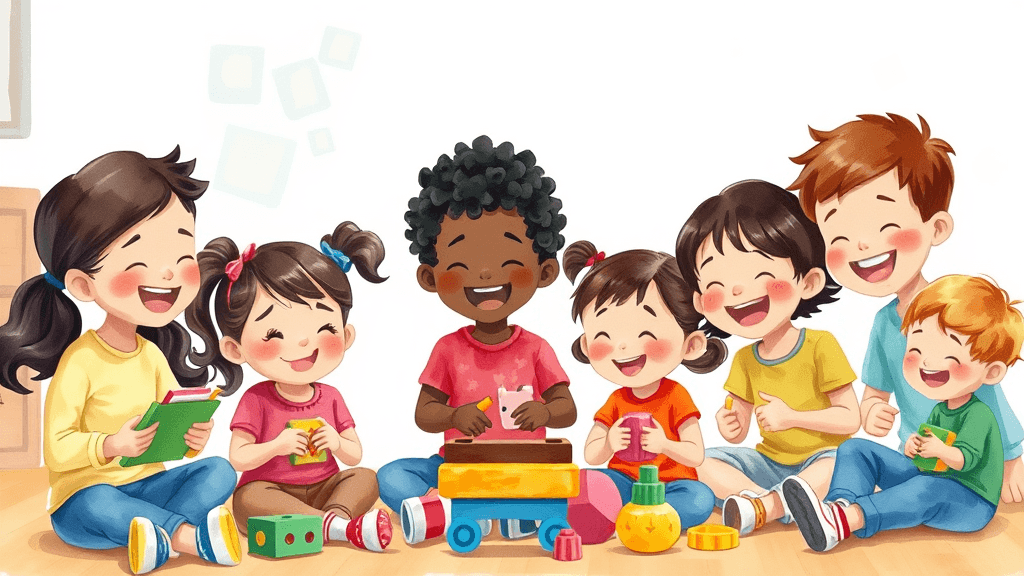
When Singapore parents think about preparing their child for Primary 1, they usually think about academics — can my child read? count to 20? write their name? But ask any Primary 1 teacher what the biggest challenge is for incoming students, and the answer is rarely academic. It is social-emotional readiness.
TL;DR: Build your child's EQ before Primary 1. Emotional regulation, empathy, conflict resolution, and social skills aligned with MOE NEL framework for K1-K2.
Can your child sit through a 30-minute lesson without a meltdown? Can they handle disappointment when they do not get what they want? Can they make friends, resolve conflicts without hitting, and ask for help when they are stuck? These skills — collectively called social-emotional learning (SEL) — are the invisible foundation that makes everything else possible.
This guide covers what social-emotional learning looks like in the MOE NEL framework, the specific skills your child needs before Primary 1, and practical strategies you can use at home to build emotional intelligence without worksheets or enrichment classes.
What the MOE NEL Framework Says About Social-Emotional Development
The MOE Nurturing Early Learners framework identifies six learning areas, and Social and Emotional Development is one of them — given equal weight alongside Language and Literacy, Numeracy, and the other four areas.
Under the NEL framework, social-emotional development covers three key competencies:
1. Awareness of Self and Environment
This is the foundation. Children learn to recognise their own emotions, understand their strengths and limitations, and develop a sense of identity within their family, school, and Singapore's multicultural society.
What this looks like in K1-K2:
- "I feel angry because he took my toy" (identifying emotions and causes)
- "I am good at building things but I need help with cutting" (self-awareness)
- "My family is Chinese and my friend's family is Malay" (cultural awareness)
2. Management of Emotions and Behaviour
Children learn to regulate their emotional responses and behaviour — not to suppress emotions, but to express them appropriately and cope with challenging situations.
What this looks like in K1-K2:
- Waiting for their turn without constant reminders
- Using words instead of hitting when frustrated
- Calming down after a disappointment within a few minutes (not instantly — that is unrealistic)
- Following classroom rules and routines
3. Responsible Decision Making and Social Awareness
Children learn to consider the needs and feelings of others, cooperate in group activities, resolve conflicts peacefully, and make choices that consider their impact on others.
What this looks like in K1-K2:
- Sharing toys and taking turns in games
- Comforting a friend who is crying
- Trying to solve a problem before asking the teacher for help
- Understanding that rules exist for everyone's benefit
Why SEL Matters More Than You Think
The Research Evidence
A landmark meta-analysis by Durlak et al. (2011), covering 213 studies and over 270,000 students, found that children who received social-emotional learning programmes showed:
- 11 percentile point gain in academic achievement
- Significant improvements in social skills, attitudes, and behaviour
- Reduced emotional distress, conduct problems, and aggression
These gains are substantial. An 11 percentile point academic improvement from social-emotional training — not academic training — underscores how fundamental these skills are to all learning.
The Primary 1 Transition
The transition from kindergarten to Primary 1 is primarily a social-emotional challenge, not an academic one. In Primary 1, your child will face:
- Larger class sizes — 30 to 40 children per class, compared to 15 to 25 in kindergarten
- Less adult attention — one teacher for 30+ children, with fewer teaching assistants
- Longer school day — from 3 to 4 hours in kindergarten to 6 to 7 hours in primary school
- Unstructured recess — navigating the canteen, making food choices, and managing social dynamics independently
- Homework and assessments — dealing with performance pressure and potential disappointment
Children who enter P1 with strong social-emotional skills adapt faster and experience less stress. Children who are academically advanced but emotionally immature often struggle more than children who are academically average but socially confident.
Building Social-Emotional Skills at Home: Age-by-Age
Ages 3-4 (Nursery to K1 Entry)
At this stage, children are just beginning to understand emotions. They feel big emotions intensely but have very limited tools to manage them. Tantrums are normal and expected.
Focus on:
Emotion vocabulary. Teach your child the words for emotions: happy, sad, angry, scared, frustrated, excited, surprised, worried. Use these words in context: "You look frustrated because the blocks keep falling down." Children cannot manage emotions they cannot name.
Validating emotions. When your child is upset, resist the urge to dismiss or minimise their feelings. "I know you are angry" is more helpful than "There is nothing to be angry about." Validation does not mean you agree with their behaviour — it means you acknowledge their experience.
Simple calming strategies. Introduce one or two calming techniques and practise them when your child is calm (not during a meltdown). Good options for this age:
- Belly breathing: "Breathe in like you are smelling a flower. Breathe out like you are blowing out a candle."
- Counting to 5 together
- Hugging a favourite stuffed animal
Ages 4-5 (K1)
By K1, children are becoming more socially aware. They start to understand that other people have feelings too, and they begin to form real friendships. Conflicts with peers become more complex.
Focus on:
Perspective-taking. Help your child understand how others feel. "How do you think your friend felt when you took his toy?" Read stories and discuss the characters' emotions: "Why do you think the rabbit was sad?" This builds the foundation of empathy.
Turn-taking and sharing. These are among the hardest social skills for preschoolers. Practise through board games, cooperative activities, and structured play. Be explicit: "First it is your turn, then it is sister's turn." Use visual timers so children can see when their turn is coming.
Conflict resolution scripts. Teach simple phrases your child can use when conflicts arise:
- "I do not like it when you do that. Please stop."
- "Can we take turns?"
- "I feel angry. I need to take a break."
Practise these through role-play when your child is calm, so they have the language available during actual conflicts.
Delayed gratification. Introduce small waiting challenges. "I will give you the snack in 3 minutes." "We can go to the playground after we finish cleaning up." The ability to wait is one of the strongest predictors of later academic and life success.
Ages 5-6 (K2)
By K2, children should have a solid emotional vocabulary, basic regulation strategies, and the ability to cooperate with peers. The focus now shifts to more complex social skills.
Focus on:
Problem-solving. When your child comes to you with a problem ("She will not let me play!"), resist solving it for them. Instead, guide them through the process: "What happened? How does that make you feel? What could you try? What do you think would happen if you did that?" This builds independence and critical thinking.
Handling disappointment. As children approach Primary 1, they need to cope with not always getting what they want — losing a game, getting a wrong answer, not being chosen for something. Normalise disappointment: "It is okay to feel sad that you lost. Everyone loses sometimes. What matters is that you tried your best."
Group dynamics. K2 children are ready for cooperative projects and group activities. These teach negotiation, compromise, and leadership. Arrange playdates that involve collaborative play — building something together, creating a performance, playing a team game.
Independence and self-advocacy. Before P1, your child should be able to ask for help from an adult who is not their parent, tell someone when they are unwell, and manage basic self-care (toileting, opening their water bottle, packing their bag). Practise these skills at home.
8 Everyday Activities That Build Social-Emotional Skills
You do not need a special programme or enrichment class to build your child's EQ. These everyday activities are some of the most effective approaches.
1. Family Mealtimes (Daily)
Eating together as a family — with screens off — is one of the most powerful SEL activities. Conversation during meals builds communication skills, active listening, and turn-taking. Ask about each person's day. Share something you found challenging and how you handled it. Model the emotional vocabulary you want your child to use.
2. Reading and Discussing Stories (Daily)
Books are a safe way to explore complex emotions. When reading with your child, pause to discuss characters' feelings and motivations. "Why did the bear run away? How do you think the rabbit felt?" Books featuring characters who face challenges and resolve them model problem-solving and resilience.
This also reinforces literacy skills — you are building EQ and reading ability simultaneously.
3. Board Games and Card Games (2-3 Times Per Week)
Games teach turn-taking, following rules, winning gracefully, and losing without a meltdown. Start with simple games (Snap, Uno, memory match) and progress to games with more strategy. When your child loses, acknowledge their feelings and model good sportsmanship: "I know it is disappointing. You played really well. Want to play again?"
4. Pretend Play (Daily)
Pretend play is the natural laboratory for social-emotional development. When children play "house" or "doctor" or "school," they practise empathy (taking on another person's role), negotiation (deciding who plays which role), conflict resolution (managing disagreements during play), and emotional expression (acting out different feelings).
Join their pretend play when invited, but let them lead. Your role is to follow, not direct.
5. Cooking Together (Weekly)
Cooking with your child teaches patience (waiting for things to cook), sequencing (following steps in order), frustration tolerance (when things do not look like the picture), and cooperation (working together towards a shared goal). Let them do age-appropriate tasks: stirring, pouring, pressing cookie cutters, washing vegetables.
6. Chores and Responsibilities (Daily)
Giving your child age-appropriate responsibilities — setting the table, putting away toys, feeding a pet, watering a plant — builds a sense of competence and contribution. It teaches them that they are a valued member of the household who can make a meaningful contribution.
7. Outdoor and Physical Play (Daily)
Outdoor play with other children provides unstructured social learning opportunities. Playground dynamics teach negotiation ("Can I have a turn on the swing?"), cooperation ("Let us build a sandcastle together"), and resilience ("I fell down, but I can get up and try again"). Ensure your child gets at least 60 minutes of outdoor play daily.
8. Emotion Check-Ins (Daily)
Create a daily ritual of checking in on emotions. This can be as simple as asking each family member to share one feeling at dinner: "Today I felt happy because..." or "Today I felt worried about..." You can use a simple emotions chart with faces for younger children who are still building their vocabulary.
When to Be Concerned About Social-Emotional Development
While normal variation is wide, some patterns may indicate the need for professional support. Consider consulting your child's kindergarten teacher or a child psychologist if your child:
- Has frequent, intense tantrums that are not decreasing in frequency by age 5
- Is consistently unable to play cooperatively with peers
- Shows no empathy or concern when others are hurt or upset
- Is excessively anxious or fearful to the point where it interferes with daily activities
- Is aggressive towards peers or adults on a regular basis
- Shows significant regression in emotional or social skills
- Has difficulty separating from parents at school after the first few weeks of adjustment
If concerns arise, your child's kindergarten teacher is usually the best first point of contact. They see your child in a social context every day and can provide valuable observations. If further assessment is needed, they can guide you to appropriate resources.
How QuizKin Supports Social-Emotional Development
While no app can replace face-to-face social interaction, QuizKin is designed with social-emotional principles built into its learning experience:
Positive reinforcement. Every correct answer receives encouraging feedback, animated star celebrations, and progress tracking. This builds a positive association with learning and reinforces effort over perfection.
Frustration management. The adaptive learning algorithm adjusts difficulty based on your child's performance, ensuring they experience an achievable level of challenge. Too easy becomes boring; too hard becomes frustrating. The sweet spot — just challenging enough — builds both competence and persistence.
Independence. Face recognition login means children can start their learning session independently, without needing a parent to type a password. This builds autonomy and a sense of ownership over their learning.
Natural stopping points. Built-in session limits prevent overstimulation and teach children that activities have a beginning and an end — a practical exercise in accepting boundaries.
Key Takeaways
- Social-emotional skills are at least as important as academic skills for Primary 1 readiness — P1 teachers consistently rank them as the biggest adjustment challenge.
- The MOE NEL framework treats Social and Emotional Development as one of six core learning areas, equal in importance to literacy and numeracy.
- Build emotional vocabulary early. Children cannot manage emotions they cannot name.
- Validate your child's emotions, even when you need to set limits on their behaviour. "I understand you are angry" and "You cannot hit" are not contradictory.
- Everyday activities — mealtimes, reading, pretend play, cooking, outdoor play — are more effective for building EQ than any enrichment programme.
- Model the emotional skills you want your child to develop. Children learn more from what you do than from what you say.
- If concerns arise, consult your child's kindergarten teacher first. Early support for social-emotional challenges is highly effective.
- QuizKin supports emotional development through positive reinforcement, adaptive difficulty, and independent learning features.
The preschool years are when the emotional foundation is laid. A child who enters Primary 1 with strong social-emotional skills — even if their reading is not perfect — is set up for long-term success.
Sources
- ECDA — Early Childhood Development Agency
- KKH — KK Women's and Children's Hospital
- HealthHub Singapore
Looking for more? Check out find a tutor for free on TuitionLah.
Exploring parenthood in Singapore? Visit ParentLah for practical tips on raising kids in Singapore.
Practise what you've read with QuizKin
Adaptive quizzes covering phonics, sight words, numbers, and more — aligned with the Singapore MOE curriculum. Free for one child.
Frequently Asked Questions
Social-emotional learning is the process through which children develop the ability to understand and manage their emotions, show empathy for others, build positive relationships, make responsible decisions, and handle challenging situations. In Singapore's MOE NEL framework, it is one of the six core learning areas for kindergarten education and is considered just as important as academic skills like literacy and numeracy.
Research consistently shows that social-emotional skills are among the strongest predictors of long-term academic success — even more predictive than early reading or maths ability. Children who can regulate their emotions, cooperate with others, and persist through challenges perform better in school, have stronger friendships, and show greater resilience. These skills also help children adjust to the social demands of Primary 1.
By K2, most children can identify basic emotions in themselves and others, use words to express how they feel (instead of only crying or hitting), take turns and share (with occasional reminders), follow classroom rules, show empathy when a friend is upset, and handle small frustrations without major meltdowns. If your child consistently struggles with several of these skills, discuss your concerns with their kindergarten teacher.
Tantrums are developmentally normal for children aged 2 to 4. They decrease in frequency and intensity as children develop emotional regulation skills. By age 5, most children should be able to manage frustration without full-blown tantrums most of the time, though occasional outbursts are still normal. If tantrums are frequent, intense, and showing no signs of decreasing at age 5 or 6, consider discussing with your child's teacher or paediatrician.
Excessive passive screen time can displace opportunities for face-to-face interaction, pretend play, and social learning — all of which are critical for social-emotional development. However, moderate screen time with quality educational content, combined with plenty of social interaction and outdoor play, does not negatively impact social-emotional development. Interactive apps that encourage problem-solving and positive reinforcement can even support emotional resilience.
Ready to make learning fun?
QuizKin turns screen time into learning time with adaptive quizzes built for K1-K2 kids in Singapore. Free to start.
Related Articles
Complete Guide to MOE's NEL Framework for Parents
Plain-English guide to Singapore's MOE NEL framework. What your K1-K2 child learns, the 6 learning areas, and how to support their development at home.

Building a Growth Mindset in Your K1-K2 Child: Tips for Singapore Parents
Help your K1-K2 child develop a growth mindset at home with practical Singapore-parent strategies — praise effort, embrace mistakes, and build resilience for school.
Preschool Maths Worksheets Singapore: What K1 and K2 Kids Actually Need to Learn (2026 Guide)
A parent's guide to preschool maths worksheets in Singapore. What MOE expects by Primary 1, which skills to focus on at K1 and K2, and how to make maths practice effective.