Preschool Maths Worksheets Singapore: What K1 and K2 Kids Actually Need to Learn (2026 Guide)
A parent's guide to preschool maths worksheets in Singapore. What MOE expects by Primary 1, which skills to focus on at K1 and K2, and how to make maths practice effective.
QuizKin Team
Published 1 May 2026
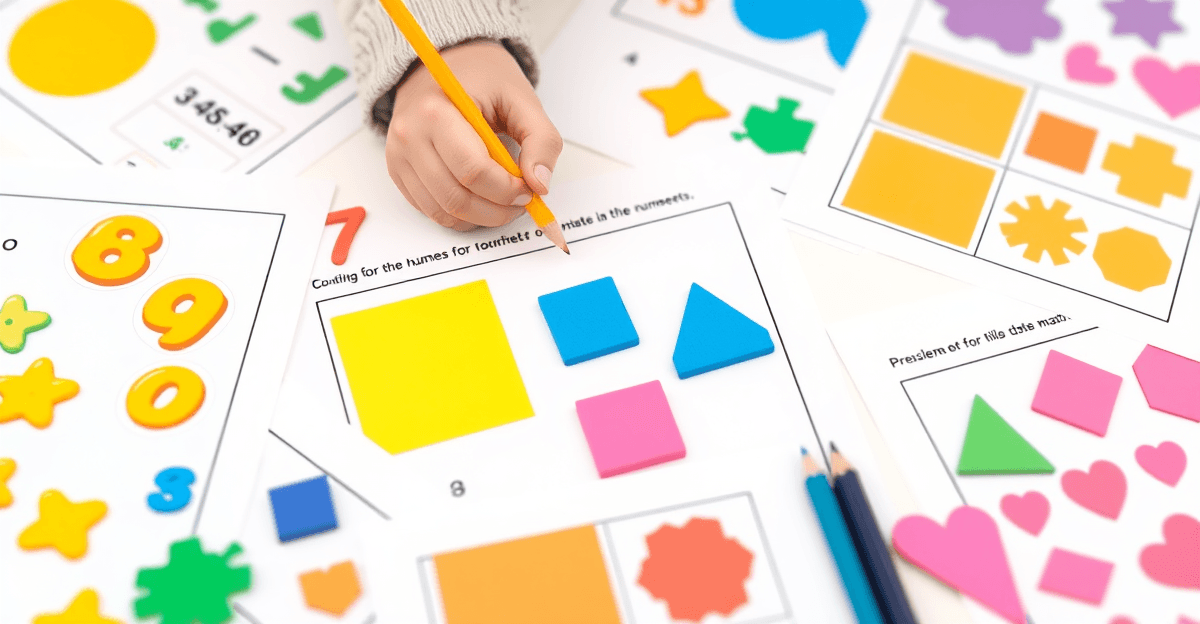
Walk into any Popular bookstore in Singapore and you will find an entire aisle of preschool maths assessment books. Walk into a parent WhatsApp group and you will find heated debates about whether K1 children should be doing addition. Open Instagram and you will find accounts showing four-year-olds completing multiplication worksheets with the caption "never too early to start."
TL;DR: A parent's guide to preschool maths worksheets in Singapore. What MOE expects by Primary 1, which skills to focus on at K1 and K2, and how to make maths practice effective.
Here is the reality: most preschool maths worksheets either cover too much or miss the point entirely. The gap between what anxious parents think their children need and what the MOE actually expects by Primary 1 is enormous. This guide bridges that gap.
We will cover what maths skills K1 and K2 children genuinely need, what makes a worksheet effective versus a waste of time, and how to build real number sense that prepares your child for Primary 1 without turning maths into a dreaded chore.
What MOE Actually Expects: The NEL Framework
The Ministry of Education's Nurturing Early Learners (NEL) framework is the official guide for what kindergarten children should learn. For maths (called "numeracy" in the framework), the expectations are far more reasonable than many parents assume.
The NEL numeracy goals focus on three areas:
- Number sense: Understanding quantities, counting, recognising numerals, and making simple comparisons
- Spatial sense: Recognising shapes, understanding position words (above, below, beside), and basic geometry
- Pattern awareness: Identifying, extending, and creating simple patterns
Notice what is absent from this list: formal addition and subtraction drills, memorising times tables, or completing pages of sums. The NEL framework deliberately emphasises understanding over drilling, and play-based learning over worksheet-based instruction.
K1 Maths Skills: What to Focus On
Counting and Number Recognition (1-20)
The single most important K1 maths skill is counting with understanding. This means your child does not just recite "one, two, three" like a song -- they understand that each number corresponds to one object.
What effective practice looks like:
- Counting real objects: toys, crackers, steps, buttons
- Matching quantities to numerals: "put 5 beads on the plate"
- One-to-one correspondence activities: touching each object while counting
What worksheets can help with:
- Numeral recognition (circling or colouring the correct number)
- Counting pictures and writing the corresponding numeral
- Tracing and writing numerals 1-10
What does not help at this stage:
- Speed drills or timed counting
- Counting beyond 20 for the sake of counting higher
- Abstract number problems without visual support
Comparing Quantities
K1 children should learn to compare groups of objects using "more," "less," and "same." This is foundational for understanding addition and subtraction later.
Practical activities that build this skill:
- "Who has more grapes, you or mei mei?"
- Pouring water between different-sized cups
- Building block towers of different heights and comparing
On QuizKin, our counting and comparison quizzes present visual groups of objects for children to compare -- building this skill through interactive practice that feels like play rather than homework.
Basic Shapes
K1 children should recognise and name four basic shapes: circle, square, triangle, and rectangle. They should also be able to identify these shapes in real-world objects.
Make it real: A clock is a circle. A door is a rectangle. A slice of pizza is a triangle. A window is a square. Shape hunts around the house or neighbourhood are far more effective than colouring worksheets.
Simple Patterns
Pattern recognition is a surprisingly important maths skill. It underpins later work in algebra, geometry, and data analysis. At K1 level, start with AB patterns (red, blue, red, blue) and progress to ABB patterns (clap, stomp, stomp, clap, stomp, stomp).
Best activities: Stringing coloured beads, arranging fruit in patterns, using stamps or stickers in repeating sequences.
K2 Maths Skills: Preparing for Primary 1
K2 ramps up the complexity, but the approach should remain the same: concrete understanding first, abstract representation second.
Counting to 50 and Beyond
K2 children should be comfortable counting to at least 50 and ideally to 100. They should also understand place value at a basic level -- knowing that 23 means "two tens and three ones."
Effective worksheet activities:
- Fill-in-the-missing-number sequences (41, __, 43, __, 45)
- Counting by 2s, 5s, and 10s
- Identifying numbers on a number line
Addition and Subtraction Within 10
This is where parents often panic and accelerate too quickly. K2 children should understand addition and subtraction as concepts -- combining groups and taking away -- before they encounter the symbols + and =.
The right progression:
- Physical objects: "You have 3 bears. I give you 2 more. How many bears now?"
- Pictures: Count the objects in two groups, find the total
- Number bonds: Understanding that 5 can be split into 3+2, 4+1, etc.
- Simple equations with symbols (only after steps 1-3 are solid)
On QuizKin, our K2 maths quizzes follow this progression. Questions use visual aids and real-world scenarios rather than abstract equations, helping children build genuine understanding.
Time and Money
K2 children should begin recognising hours on an analog clock and identifying Singapore coins (5c, 10c, 20c, 50c, $1).
Real-world practice: Let your child pay for small items at the mama shop. Play "shop" at home with real coins. Point out the clock at regular daily events: "It is 7 o'clock, time for breakfast."
2D and 3D Shapes
Building on K1 shape knowledge, K2 children should recognise additional shapes (oval, diamond, hexagon) and begin understanding 3D shapes (cube, sphere, cylinder, cone).
Best activity: Building with blocks, Play-Doh, and Lego. Asking: "What shape is this box? How many sides does it have?"
What Makes a Good Preschool Maths Worksheet
Not all worksheets are created equal. Here is how to evaluate whether a worksheet will actually help your child learn.
Good worksheets:
- Focus on one skill at a time (just counting, or just shapes, not everything at once)
- Use clear, age-appropriate illustrations
- Include a mix of activity types (circling, colouring, drawing, matching)
- Take 5-10 minutes to complete (not 30 minutes)
- Allow for multiple correct approaches
Bad worksheets:
- Cram multiple unrelated skills onto one page
- Use tiny, cluttered illustrations that confuse rather than clarify
- Require fine motor skills beyond the child's ability (tiny writing spaces)
- Are purely repetitive with no variation (20 identical sums in a row)
- Include content well above the child's developmental stage
Beyond Worksheets: Building Number Sense in Daily Life
The most powerful maths learning for preschoolers happens outside of worksheets entirely. Here are ten everyday activities that build stronger number sense than any assessment book.
- Cooking together: Measuring cups, counting eggs, timing with a clock
- Grocery shopping: Counting items, comparing prices, weighing fruits
- Setting the table: "We need 4 plates. How many forks do we need?"
- Board games: Snakes and ladders, card games with number matching
- Building with blocks: Counting, sorting by size, creating patterns
- Bath time: Counting ducks, comparing water levels
- Walks: Counting steps, looking for shapes, reading house numbers
- Bedtime stories: Books with counting themes (The Very Hungry Caterpillar, Ten Little Fingers)
- Playground: Counting swings, comparing heights, taking turns (ordinal numbers)
- Digital practice: Short, focused sessions on educational apps like QuizKin that make maths practice feel like a game
Recommended Resources for Singapore Parents
Free worksheet sources:
- MOE Kindergarten resources (available through MOE website)
- Singapore public library (printable activity sheets)
- Teacher-created resources on SgExams forum
Assessment books (use sparingly):
- Shichida-method maths workbooks (focus on visual number sense)
- Marshall Cavendish preschool maths series (aligned to Singapore curriculum)
- Earlybird Kindergarten Mathematics (by the creators of Primary Math)
Educational apps:
- QuizKin -- designed for Singapore N2/K1/K2 with local curriculum alignment
- Khan Academy Kids -- free, high quality, but US-based curriculum
- Todo Math -- gamified maths practice
The Bottom Line: What Your Child Actually Needs
Your K1 or K2 child does not need to be doing Primary 1 maths. They need strong number sense -- an intuitive understanding of how numbers work, what quantities mean, and how maths connects to the real world.
Worksheets can support this, but they are not the main event. Cooking, shopping, playing, building, and talking about numbers in everyday life builds the mathematical thinking that will carry your child through Primary 1 and beyond.
If you want structured, curriculum-aligned maths practice that feels like play rather than homework, try QuizKin's free maths quizzes designed specifically for Singapore preschoolers. Short sessions, visual questions, and instant feedback that builds confidence without the tears.
Sources
- MOE — Preschool Education
- ECDA — Early Childhood Development Agency
- MOE — Nurturing Early Learners Framework
Looking for more? Check out find a tutor for free on TuitionLah.
Exploring parenthood in Singapore? Visit ParentLah for practical tips on raising kids in Singapore.
Practise what you've read with QuizKin
Adaptive quizzes covering phonics, sight words, numbers, and more — aligned with the Singapore MOE curriculum. Free for one child.
Frequently Asked Questions
By the end of K1, your child should be able to: count from 1 to 20 with one-to-one correspondence, recognise written numerals 1-10, compare quantities using 'more', 'less', and 'same', identify basic shapes (circle, square, triangle, rectangle), understand simple patterns (AB, ABB), and sort objects by colour, shape, or size. These skills align with the MOE Nurturing Early Learners (NEL) framework for kindergarten numeracy.
Before entering Primary 1, K2 children should be comfortable with: counting to 50 or beyond, recognising and writing numerals 1-20, simple addition and subtraction within 10 (using objects, not abstract sums), understanding ordinal numbers (1st, 2nd, 3rd), telling time to the hour, recognising coins (5c, 10c, 20c, 50c, $1), identifying 2D and 3D shapes, and following multi-step patterns.
Worksheets are one tool among many and work best when combined with hands-on activities and real-world maths. For preschoolers, worksheets should be short (5-10 minutes), visually engaging, and focused on one skill at a time. They are useful for practising numeral writing, basic counting, and pattern recognition. However, children learn maths most effectively through play, manipulation of physical objects, and everyday activities like cooking and shopping.
For K1 children, 10-15 minutes of focused maths activity per day is sufficient. For K2 children, 15-20 minutes works well. This does not need to be worksheets -- it can include educational apps like QuizKin, counting games, cooking together, or sorting household objects. Consistency matters more than duration. A short daily practice builds stronger number sense than occasional long sessions.
The best maths apps for Singapore preschoolers align with the MOE NEL framework and use the Singapore context. QuizKin is designed specifically for N2, K1, and K2 children in Singapore, covering numeracy skills through interactive quizzes and games that follow local curriculum expectations. Other options include Khan Academy Kids (free, US-based curriculum) and Todo Math (international). Choose apps that limit passive screen time and require active problem-solving.
Ready to make learning fun?
QuizKin turns screen time into learning time with adaptive quizzes built for K1-K2 kids in Singapore. Free to start.
Related Articles
How to Teach Your Preschooler to Write in Singapore: A Step-by-Step Guide for Parents (2026)
Practical guide for Singapore parents teaching K1 and K2 children to write. Handwriting readiness, letter formation, pencil grip, and when to start. Aligned with MOE expectations.
Teaching Addition and Subtraction to Preschoolers in Singapore: A Parent's Guide (2026)
Practical guide to teaching addition and subtraction to K1 and K2 children in Singapore. Hands-on activities, MOE-aligned progression, and common mistakes to avoid.
Teaching Numbers & Counting to Preschoolers (Singapore)
Teach your K1-K2 child numbers and counting with 10 fun activities. Covers number recognition, counting skills, and basic addition for Singapore parents.