Teaching Addition and Subtraction to Preschoolers in Singapore: A Parent's Guide (2026)
Practical guide to teaching addition and subtraction to K1 and K2 children in Singapore. Hands-on activities, MOE-aligned progression, and common mistakes to avoid.
QuizKin Team
Published 30 April 2026
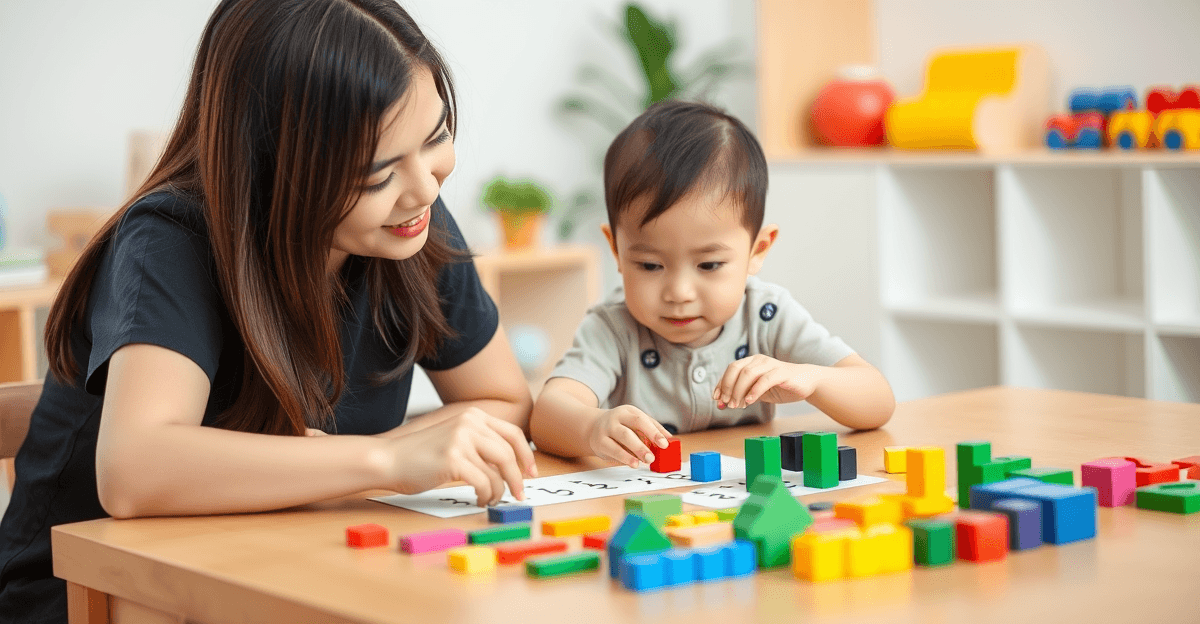
Your four-year-old can count to twenty. They can recognise numbers on doors, lift buttons, and bus stops. They might even be able to count a pile of grapes accurately, touching each one as they go. So naturally, you wonder: is it time to teach addition and subtraction?
TL;DR: Practical guide to teaching addition and subtraction to K1 and K2 children in Singapore. Hands-on activities, MOE-aligned progression, and common mistakes to avoid.
The answer is yes -- but probably not the way you think. Teaching early arithmetic to a preschooler does not mean sitting them down with a worksheet of "3 + 2 = ___" problems. It means giving them experiences that build the underlying concepts: combining groups, taking away from groups, comparing quantities, and understanding that numbers represent real things.
This guide covers how to teach addition and subtraction to K1 and K2 children in Singapore, following the Concrete-Pictorial-Abstract progression that makes Singapore's math education world-renowned. Every activity is designed to be done at home with materials you already have.
Before Addition: Make Sure the Foundations Are Solid
Addition and subtraction build on several prerequisite skills. If these are not yet in place, focus on them first. Rushing into operations before the foundations are solid is the most common mistake parents make.
Prerequisite 1: Stable Counting (to at least 10)
Your child should be able to count objects reliably -- not just recite numbers, but point to each object and count it once, arriving at the correct total. This is called one-to-one correspondence.
Test it: Put 7 small toys on the table. Ask your child to count them. Do they touch each toy exactly once? Do they arrive at 7? Can they do it consistently, not just sometimes?
Prerequisite 2: Cardinality
When your child finishes counting 7 toys and you ask "How many toys are there?", they should answer "7" immediately -- without recounting. This understanding that the last number counted represents the total quantity is called cardinality. It typically develops between ages 3 and 4.
Test it: After your child counts a group of objects, ask "So how many are there?" If they start counting again from 1, they do not yet have cardinality. Keep practising counting with real objects.
Prerequisite 3: Number Recognition (1-10)
Your child should recognise written numerals and connect them to quantities. They should know that the symbol "5" represents five things.
Test it: Hold up number cards or point to numbers in books. "What number is this?" If your child can reliably identify 1-10, they are ready.
Prerequisite 4: Comparing Quantities (More, Less, Same)
Your child should be able to look at two groups of objects and determine which has more, which has less, or if they are the same.
Test it: Put 3 blocks on one side and 5 on the other. "Which group has more?" If your child can answer consistently (even if they need to count each group), this skill is developing well.
The CPA Approach: Singapore's Secret Weapon
Singapore's mathematics education is built on the Concrete-Pictorial-Abstract (CPA) framework, developed by Jerome Bruner and refined by the Singapore education system. This approach is a major reason Singapore students consistently top global mathematics rankings.
Stage 1: Concrete (Hands-On)
Children manipulate real, physical objects to understand mathematical concepts. They combine groups of toy cars, remove grapes from a plate, or share stickers among friends. This is where all early math learning should begin.
Duration at preschool level: This stage should last for weeks or months, not days. Do not rush to the next stage.
Stage 2: Pictorial (Visual)
Children work with pictures, diagrams, and drawings that represent the physical objects. They might draw circles to represent apples, or use picture cards showing groups of objects. The pictorial stage bridges the gap between touching real things and working with abstract symbols.
When to introduce: Once your child can confidently perform an operation with physical objects AND explain what they are doing ("I had 4, I took 1 away, now I have 3").
Stage 3: Abstract (Symbols)
Children work with written numbers and operation signs (+, -, =). This is where equations like "3 + 2 = 5" appear. In Singapore's curriculum, this stage is primarily introduced in Primary 1, not in kindergarten.
Important: Most K1 and K2 children are working in the Concrete and early Pictorial stages. If your preschooler is writing equations, they have likely been pushed to the Abstract stage too early. Go back to Concrete.
Teaching Addition: Hands-On Activities
Activity 1: The Combining Game (K1 Level)
Materials: 10 small toys, snacks, or blocks
How to play:
- Put 3 toys on the left side of the table
- Put 2 toys on the right side
- Say: "You have 3 cars here and 2 cars here. Let's push them together. How many cars do you have now?"
- Let your child physically push the groups together and count the total
- Repeat with different combinations
Key language: "How many altogether?" "How many when we put them together?" "If we combine these two groups..."
Why it works: Your child physically experiences addition -- combining two separate groups into one larger group. They can see and touch every object.
Activity 2: The Snack Math Game (K1-K2 Level)
Materials: Small snacks (grapes, biscuits, cherry tomatoes)
How to play:
- Give your child a plate with 4 grapes
- Say: "You have 4 grapes. I am going to give you 3 more. How many will you have?"
- Before adding the grapes, let your child predict (guess is fine)
- Add the 3 grapes to the plate
- Let your child count the total
- Compare the prediction with the actual count
Why it works: Real food makes the math meaningful. Your child cares about how many grapes they have. This emotional investment deepens learning.
Activity 3: Dice Addition (K2 Level)
Materials: Two dice, paper and crayons (optional)
How to play:
- Roll both dice
- Count the dots on each die separately
- Combine: "This die shows 3 and this die shows 4. How many dots altogether?"
- Your child can count all dots across both dice to find the answer
- Optional: draw the dots on paper to create a pictorial record
Why it works: Dice provide random number combinations, so your child practises many different pairs. The dots are a built-in concrete representation.
Activity 4: Number Story Mat (K2 Level)
Materials: A placemat or piece of paper divided into two sections (draw a line down the middle), small toys or counters
How to play:
- Tell a story: "There were 5 birds sitting on a fence [place 5 counters on the left side]. Then 3 more birds came to join them [place 3 counters on the right side]."
- Ask: "How many birds are on the fence now?"
- Let your child move all counters to one side and count
Why it works: Stories give context to addition, helping children understand when addition is used in real life.
Teaching Subtraction: Hands-On Activities
Activity 5: The Taking Away Game (K1 Level)
Materials: 10 small toys or snacks
How to play:
- Put 5 toys in a line
- Say: "You have 5 teddy bears. 2 teddy bears go home to sleep. How many teddy bears are left?"
- Let your child physically remove 2 toys and count what remains
- Repeat with different starting numbers and amounts removed
Key language: "How many are left?" "If we take away..." "How many remain?"
Why it works: Subtraction is physically experienced as removal. The child sees the group get smaller.
Activity 6: The Hiding Game (K1-K2 Level)
Materials: 5-8 small objects and a cup or box
How to play:
- Count 6 objects together with your child
- While your child watches, hide 2 objects under the cup
- Ask: "We had 6. I hid 2. How many are still on the table?"
- Your child counts what remains (4)
- Lift the cup to verify: "Yes! 6 take away 2 is 4."
Why it works: This builds the connection between subtraction and the concept of "missing" -- a foundation for later word problems.
Activity 7: Eating Subtraction (K1-K2 Level)
Materials: Snacks on a plate
How to play:
- Count the snacks together: "You have 8 blueberries."
- Say: "Eat 3 blueberries."
- After eating: "How many are left?"
- Count together to verify
Why it works: You cannot get more immediate than eating your math problems. Subtraction becomes a lived experience.
Activity 8: Number Stories Going Backwards (K2 Level)
Materials: Toys or counters on the number story mat
How to play:
- Tell a story: "There were 7 ducks in the pond [place 7 counters]. Then 3 ducks flew away [remove 3 counters]. How many ducks are still in the pond?"
- Your child counts the remaining counters
Variation: Let your child create their own subtraction stories. "There were 9 cars in the car park. Then some drove away. There are 4 left. How many drove away?"
Common Mistakes Parents Make
1. Skipping the Concrete Stage
The most damaging mistake is jumping straight to written equations. A child who can write "3 + 2 = 5" on a worksheet may not understand what it means. They are pattern-matching, not doing mathematics.
Fix: Spend weeks (not days) at the Concrete stage. Only move to Pictorial when your child can explain the concept in their own words.
2. Drilling Number Facts
Memorising "2 + 3 = 5" without understanding is fragile knowledge. It does not transfer to new situations, and it often crumbles under the complexity of Primary 1 math.
Fix: Focus on understanding through experience. Fluency with number facts will develop naturally over time, reinforced by the experiences your child has had.
3. Using Fingers as a Crutch
Fingers are a legitimate mathematical tool -- research supports their use. But some children become so dependent on finger counting that they never develop mental strategies.
Fix: Allow fingers as one tool among many. Also use objects, number lines, dot patterns (like on dice), and ten-frames. Variety builds flexibility.
4. Correcting Too Quickly
When your child says "3 + 2 is 4," resist the urge to immediately say "No, it's 5." Instead, guide them to self-correct: "Let's check. Can you count the objects again?"
Fix: Let mistakes be learning opportunities. A child who discovers their own error understands it more deeply than a child who is told the right answer.
5. Comparing with Other Children
"My friend's daughter can already do addition up to 20." Every child develops at a different pace. Comparing creates anxiety for both parent and child.
Fix: Focus on your child's progress relative to their own starting point. Celebrate effort and understanding, not speed or correct answers.
How QuizKin Supports Early Math Learning
QuizKin's kindergarten math activities follow the CPA approach, providing:
- Counting practice: Interactive counting games with visual manipulatives
- Number recognition: Games that connect numerals to quantities
- Early operations: Addition and subtraction activities using pictures and objects -- no abstract symbols before the child is ready
- MOE alignment: All content follows Singapore's Nurturing Early Learners (NEL) framework
QuizKin is designed for K1 and K2 children in Singapore. All activities are self-paced, letting your child build confidence without pressure.
A Weekly Math Play Schedule
Here is a sample weekly routine for building addition and subtraction skills at home. Each activity takes 10-15 minutes.
Monday: Snack math (addition with real food during snack time)
Tuesday: Dice addition game (roll and count)
Wednesday: Subtraction stories (use toys to act out stories)
Thursday: QuizKin math activities on the app (10-15 minutes of interactive practice)
Friday: Free play with blocks or Lego -- build towers and count, combine groups, take away
Weekend: Real-world math -- count items at the supermarket, share snacks equally among family members, count stairs as you climb
The Big Picture: What K1 and K2 Children Should Know
By the end of K2 (before entering Primary 1), Singapore children are expected to:
- Count reliably to at least 20
- Recognise and write numerals 1-20
- Understand addition as combining groups (with totals up to 10)
- Understand subtraction as taking away (from groups up to 10)
- Compare numbers and quantities (more, less, same)
- Recognise and name basic shapes
- Understand simple patterns (AB, AAB, ABB)
- Sort objects by one attribute (colour, size, shape)
This is a guide, not a checklist. Children develop at different rates, and most of these skills solidify in the first year of primary school. Your job as a parent is to provide rich mathematical experiences -- not to ensure mastery before Primary 1.
Related guides: Counting and Numbers Activities for Preschoolers | Kindergarten Math Games Singapore | K1 & K2 Readiness Checklist | Prepare Your Child for Primary 1 | Fine Motor Skills and Handwriting Readiness
Sources
Looking for more? Check out find a tutor for free on TuitionLah.
Exploring parenthood in Singapore? Visit ParentLah for practical tips on raising kids in Singapore.
Practise what you've read with QuizKin
Adaptive quizzes covering phonics, sight words, numbers, and more — aligned with the Singapore MOE curriculum. Free for one child.
Frequently Asked Questions
Most children are ready for informal addition and subtraction concepts around age 4 (K1 level), once they can count reliably to at least 10 and understand one-to-one correspondence (touching each object while counting). Formal written equations are not appropriate until Primary 1. Before age 4, focus on counting, number recognition, and comparing quantities (more/less).
At K1 level, children should be exploring addition and subtraction through concrete hands-on activities -- combining groups of objects and taking objects away. They do not need to write equations or memorise number facts. The MOE Nurturing Early Learners framework emphasises understanding concepts through play and real-world contexts, not drilling arithmetic.
Singapore's approach to early mathematics follows the Concrete-Pictorial-Abstract (CPA) progression. Children first manipulate physical objects (concrete), then work with pictures and diagrams (pictorial), and only then move to symbols and equations (abstract). Many other countries jump to abstract symbols too early. The CPA approach builds deeper understanding and is a key reason Singapore students consistently rank among the world's best in mathematics.
Yes, completely normal. Counting by rote (reciting numbers in order) is a different skill from understanding quantity and number operations. A child who can count to 20 may not yet understand that 3 + 2 means combining a group of 3 with a group of 2. This understanding develops through concrete experience -- physically combining groups of objects. Keep practising with manipulatives and the abstract understanding will follow.
Worksheets are not recommended as the primary learning tool for preschoolers. At this age, children learn mathematics best through hands-on manipulation of real objects, not through symbols on paper. Worksheets can reinforce skills that have already been understood concretely, but they should not be the first introduction to a concept. If you use worksheets, limit them to 5-10 minutes and always pair them with hands-on activities.
Ready to make learning fun?
QuizKin turns screen time into learning time with adaptive quizzes built for K1-K2 kids in Singapore. Free to start.
Related Articles
Preschool Maths Worksheets Singapore: What K1 and K2 Kids Actually Need to Learn (2026 Guide)
A parent's guide to preschool maths worksheets in Singapore. What MOE expects by Primary 1, which skills to focus on at K1 and K2, and how to make maths practice effective.
10 Kindergarten Math Games That Actually Work (Singapore Parents)
Fun, no-prep math games for K1-K2 kids at home. Build number sense, counting, addition, shapes, and patterns with activities aligned to the Singapore MOE NEL framework.
15 Easy Kindergarten Science Experiments to Do at Home in Singapore (K1-K2, 2026)
Fun and educational science experiments for K1 and K2 children in Singapore. Simple materials, real learning outcomes. Build curiosity, observation skills, and early STEM foundations at home.