Primary 1 Readiness: 30 Skills Your Child Needs (2027 Checklist)
Complete P1 readiness checklist for Singapore children entering Primary 1 in 2027. Covers reading, writing, math, social skills, and independence — with actionable tips to close any gaps.
QuizKin Team
Published 18 May 2026

If your child is entering Primary 1 in January 2027, the K2 year is your window to close any gaps. Singapore primary schools expect a baseline level of literacy, numeracy, and independence that goes beyond what many parents realise.
TL;DR: Complete P1 readiness checklist for Singapore children entering Primary 1 in 2027. Covers reading, writing, math, social skills, and independence — with actionable tips to close any gaps.
This checklist is based on the MOE NEL framework, feedback from P1 teachers, and the actual P1 curriculum expectations. It covers 30 specific, measurable skills grouped into five areas. Use it as a diagnostic tool — tick off what your child can already do, and focus your remaining K2 months on the gaps.
Reading and Language (Skills 1-8)
These are the most critical skills for a smooth P1 transition. Children who arrive at Primary 1 with strong phonics and some reading ability adjust faster and feel more confident. For a step-by-step approach to building these skills, see our complete guide to teaching your child to read at home.
1. Recognise all 26 uppercase and lowercase letters
Your child should instantly name or sound out any letter shown to them, without hesitation. If there are still letters they confuse (common: b/d, p/q, m/w), target those specifically.
2. Know the sound each letter makes
Letter sounds, not letter names, are what your child needs for reading. M says /m/, not "em". S says /sss/, not "ess".
3. Blend CVC words
Sound out and blend three-letter words: c-a-t = cat, d-o-g = dog, s-u-n = sun. This is the core phonics skill. If your child can do this, they can learn to read.
4. Recognise 30-50 sight words
High-frequency words like "the", "is", "and", "was", "said" appear so often that children need to recognise them instantly rather than sounding them out each time. See our complete sight word list for K1-K2.
5. Read simple sentences
"The cat sat on the mat." "I can see a big dog." Your child does not need to read chapter books — but reading a simple 5-7 word sentence independently is the target.
6. Understand what they read
Comprehension matters as much as decoding. After reading a sentence, can your child answer "What did the cat do?" Reading without understanding is just word-calling.
7. Listen to a story and retell the main events
Read a short picture book together and ask your child to tell you what happened. This builds narrative comprehension and sequencing skills.
8. Speak in complete sentences
"I want water" not "Water." "The boy is running because the dog is chasing him" not "Boy running." If your child's speech seems behind, read our guide on speech and language milestones.
Writing and Motor Skills (Skills 9-14)
P1 involves a significant amount of writing from the first week. Children with weak pencil grip or poor letter formation struggle unnecessarily.
9. Write their own name clearly
First name, correctly spelled, with a capital first letter and lowercase for the rest. Legible enough for others to read.
10. Write all 26 uppercase letters from memory
Not tracing — writing from memory on a blank line. Formation does not need to be perfect, but each letter should be recognisable.
11. Write all 26 lowercase letters from memory
Lowercase letters are harder because many look similar. Focus on consistent size and correct formation, especially for b, d, g, p, q.
12. Hold a pencil with a tripod grip
Three fingers (thumb, index, middle) holding the pencil near the tip. If your child still uses a fist grip at K2, work on this actively. Our guide on fine motor skills and handwriting readiness has specific exercises.
13. Write on lined paper
Letters should sit on the baseline and stay within the lines. This requires spatial awareness that develops with practice.
14. Copy a short sentence from a board
P1 teachers write on the whiteboard and expect children to copy into their exercise books. This requires the ability to look up, remember a few words, look down, and write — a surprisingly complex skill.
Numeracy (Skills 15-22)
The P1 math curriculum moves quickly. Children with strong number sense from kindergarten have a significant advantage.
15. Count to 30 (and beyond)
Forward counting to at least 30, with one-to-one correspondence (touching each object as they count). Many K2 children can count to 100.
16. Count backwards from 10
10, 9, 8, 7... This is harder than it sounds and is important for subtraction readiness.
17. Recognise and write numerals 0-20
Show any numeral between 0 and 20 and your child should name it instantly. They should also write any numeral from dictation.
18. Compare quantities
"Which group has more?" "Are there enough cups for everyone?" Understanding more, less, equal, and not enough.
19. Simple addition with objects
"You have 3 blocks and I give you 2 more. How many do you have now?" Using concrete objects, not written sums. See our kindergarten math games guide for activities.
20. Simple subtraction with objects
"You have 5 grapes and you eat 2. How many are left?" Again, concrete and hands-on at this stage.
21. Recognise basic 2D and 3D shapes
Circle, square, triangle, rectangle (2D). Sphere, cube, cylinder, cone (3D). Name them and find examples in the environment.
22. Understand simple patterns
Identify and extend patterns: red-blue-red-blue-? Circle-square-circle-square-?
Social and Emotional Skills (Skills 23-27)
Teachers consistently say that social readiness matters as much as academic readiness. A child who can read but cannot sit still, follow instructions, or get along with classmates will struggle.
23. Follow multi-step instructions
"Take out your English book, open to page 12, and write your name at the top." Three steps, in sequence, without reminders.
24. Sit and focus for 30 minutes
P1 lessons are 30 minutes. Your child needs to sit at a desk, pay attention, and resist the urge to move around or chat with neighbours.
25. Take turns and share
Group work, queuing for recess, sharing materials — these happen dozens of times daily in P1.
26. Ask for help when stuck
"Teacher, I don't understand" is a crucial sentence. Children who sit silently when confused fall behind quickly.
27. Handle minor conflicts without adult intervention
"You took my eraser" situations happen constantly. Your child should be able to use words, not hands, and resolve simple disputes. Our guide on social-emotional learning covers this in depth.
Independence and Life Skills (Skills 28-30)
P1 is the first time many children manage daily tasks without adult help. Schools expect a baseline level of self-sufficiency.
28. Pack and unpack their school bag
Know what goes in the bag each day, find the right book for each lesson, and keep the bag reasonably organised.
29. Buy food at the canteen
Handle money, queue, order food, carry a tray, and eat within the 30-minute recess window. Practise at hawker centres.
30. Use the toilet independently
Including wiping, flushing, washing hands, and managing buttons or zips. No teacher assistance available at P1.
How to Close Gaps in the K2 Year
If your child has gaps in this checklist, do not panic — you have the entire K2 year to work on them. Here is a prioritised approach:
Months 1-3 (January to March): Focus on phonics and letter sounds. If your child does not know all letter sounds, this is the single highest-priority gap to close. Use QuizKin's phonics quizzes for daily 10-minute practice.
Months 4-6 (April to June): Add sight words and simple reading. Continue phonics and layer in sight word recognition and CVC word blending.
Months 7-9 (July to September): Shift to writing and numeracy. Practise letter and number writing on lined paper. Play math games daily.
Months 10-12 (October to December): Focus on independence and social skills. Start letting your child pack their own bag, handle money, and manage daily routines with minimal help.
Routine Changes to Prepare For
The daily routine in primary school is significantly different from kindergarten. Start adjusting 2-3 months before P1 begins.
Sleep Schedule
- P1 start time: Typically 7:30am, meaning your child needs to wake up by 6:00-6:30am
- Recommended bedtime: 8:00-8:30pm for a 6-7 year old
- Start adjusting: Begin shifting bedtime and wake time gradually — 15 minutes earlier each week
Morning Routine
Practise a morning routine that your child can do with minimal supervision:
- Wake up
- Use the toilet and wash up
- Get dressed in school uniform (which they have laid out the night before)
- Eat breakfast
- Check school bag is packed (using a checklist on the fridge)
- Put on shoes
- Leave the house
Pro tip: Practise this routine during the December holidays. Run it as a "dress rehearsal" several times so it becomes second nature.
Recess Survival
Recess is often the most stressful part of P1 for children. They must navigate a crowded canteen, choose and buy food, handle money, find a seat, eat within a limited time, and find their way back to class.
Preparation tips:
- Practise buying food at a hawker centre — let your child order and pay
- Practise eating within 20 minutes
- Send a packed lunch for the first few weeks to reduce stress
- Visit the school canteen during any orientation events
What NOT to Worry About
You do not need to finish the P1 syllabus before P1 starts. Some parents enrol their child in P1 preparation classes that teach the entire first-term P1 curriculum. This is unnecessary and can be counterproductive — a child who already knows the material may become bored and disengaged in class.
Your child does not need to read chapter books. P1 English starts with simple sentences and short passages. Fluent reading develops throughout P1 and P2.
Handwriting does not need to be perfect. P1 teachers expect neat, legible writing — not calligraphy. Correct pencil grip, proper letter formation, and the ability to write on lined paper are sufficient.
A slow start is normal. Many children struggle in the first 2-4 weeks and then settle in. Tearful mornings, complaints about being tired, and lower-than-expected test scores are all common and almost always temporary.
Essential Supplies for P1
School Bag
- Ergonomic design with padded straps
- Not too big — your child should be able to pack and unpack it independently
- Waterproof or water-resistant base
Stationery
- 2B pencils (standard for P1 in Singapore)
- Eraser, 15cm ruler, sharpener with a container
- Colour pencils (12 colours is enough)
- Glue stick, scissors (child-safe)
- A simple pencil case your child can open and close easily
Lunch
- A lunchbox your child can open independently (practise at home)
- A water bottle with a no-spill cap
- A small towel or napkin
The Bottom Line
Primary 1 readiness is not about being the smartest child in the class — it is about having a broad enough foundation that your child can handle the pace and expectations of formal schooling without feeling overwhelmed.
Use this checklist as a diagnostic tool, not a source of anxiety. Every child develops at their own pace. The K2 year is long enough to close most gaps with consistent, daily practice. Start with the fundamentals — phonics, number sense, and independence — and build from there.
For a broader overview of the entire P1 preparation journey — including registration timelines, the Learning Support Programme, and emotional readiness — see our complete Primary 1 preparation guide. If you are earlier in the process, our K1-K2 readiness checklist covers the foundational skills that lead up to P1 readiness.
Sources
- MOE — Primary 1 Registration
- MOE — Primary School Education
- ECDA — Early Childhood Development Agency
Looking for more? Check out find a tutor for free on TuitionLah.
Exploring parenthood in Singapore? Visit ParentLah for practical tips on raising kids in Singapore.
Practise what you've read with QuizKin
Adaptive quizzes covering phonics, sight words, numbers, and more — aligned with the Singapore MOE curriculum. Free for one child.
Frequently Asked Questions
A P1-ready child should recognise all 26 letters and their sounds, read simple 3-4 letter words, count to at least 30, write their own name, follow multi-step instructions, sit still for 30 minutes, manage their own belongings, and use the toilet independently. Social skills like taking turns, asking for help, and resolving minor conflicts are equally important.
Not necessarily. Singapore primary schools teach reading from scratch in P1. However, children who enter P1 with strong phonics skills and some sight word knowledge adjust faster and feel more confident. If your child knows letter sounds and can blend simple CVC words (cat, dog, sun), they have a solid head start.
Read aloud daily for 15-20 minutes, practise letter sounds and sight words using an app like QuizKin, play counting and math games at home, visit the school before the first day, and gradually build independence skills (packing bag, buying food, using the toilet alone). Consistency matters more than intensity — 15 minutes of daily practice is better than weekend cramming.
Start building foundational skills from K1 (age 4-5) and intensify practice in the K2 year. The 6 months before P1 entry (July to December of K2) are the most impactful for targeted preparation. Focus on phonics and reading first, then numeracy, then independence and social skills.
Most educators say the biggest adjustment is not academic but social and behavioural. Primary school classes are larger (30-40 children vs 15-25 in kindergarten), the day is longer, recess is unstructured, and children must be more independent. Building self-help skills and social confidence is at least as important as academic preparation.
Fluent reading is not expected at P1 entry. Your child should be able to read simple sentences and recognise common sight words, but the P1 English curriculum assumes children are still developing their reading skills. What matters more is that your child has phonics skills (can sound out unfamiliar words) and enjoys books.
Ready to make learning fun?
QuizKin turns screen time into learning time with adaptive quizzes built for K1-K2 kids in Singapore. Free to start.
Related Articles
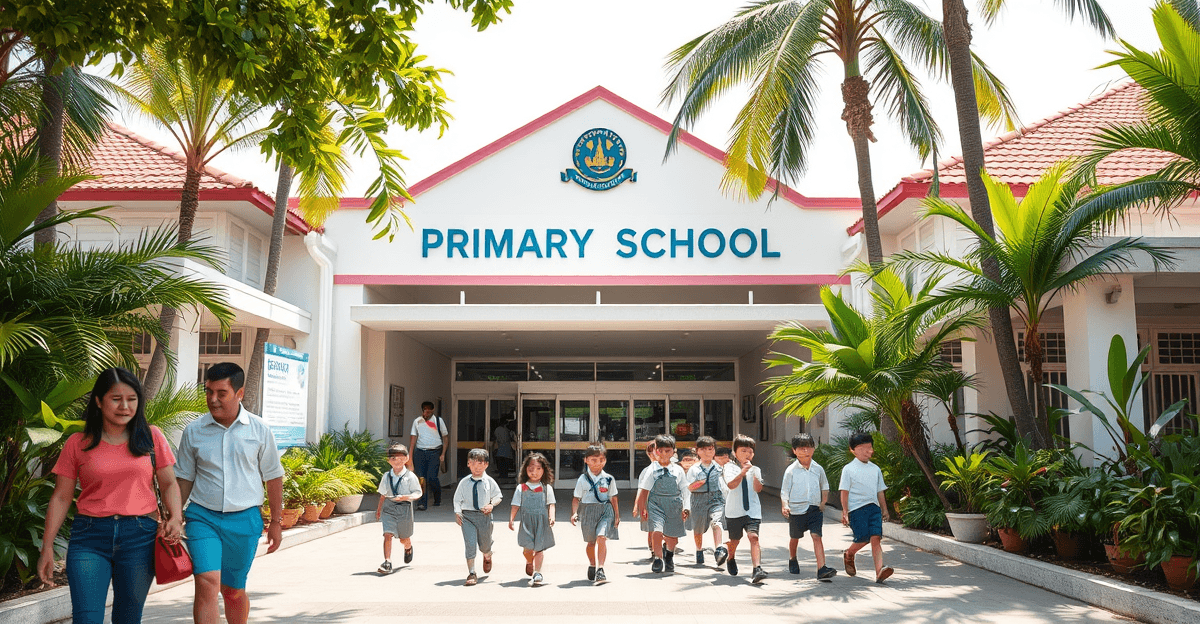
Primary 1 Registration 2026 Singapore: Phases, Dates & Complete Guide
Complete guide to P1 registration 2026 in Singapore — phases, key dates, documents needed, balloting process, school selection tips, and how to prepare your child academically.

Building Good Study Habits in Kindergarten: A Singapore Parent's Guide
How to build lasting study habits in K1 and K2 children — without pressure or tears. Evidence-based strategies tailored for Singapore families.
How to Choose a Kindergarten in Singapore (2026)
Compare MOE Kindergarten, PCF, NTUC, and private preschools in Singapore. Fees, curriculum, teacher quality, and what to look for during kindergarten visits.