How to Teach Your Child Chinese Characters at Home (Singapore)
Teach your K1-K2 child Chinese characters at home. Covers stroke order, radicals, daily practice routines, and bilingual learning tips for Singapore parents.
QuizKin Team
Published 23 April 2026
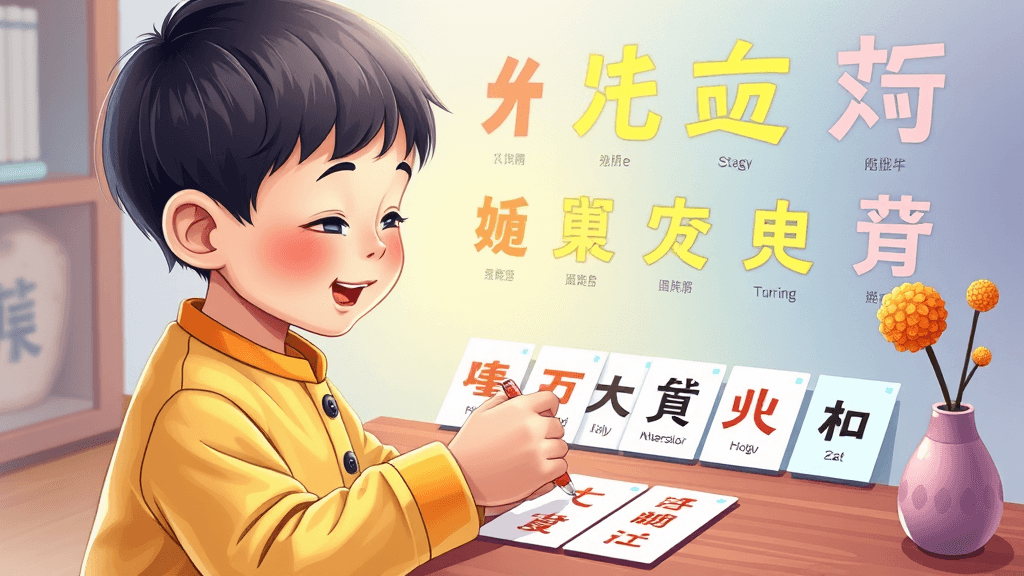
For many Singapore parents, Chinese is the subject that keeps them up at night. You want your child to be bilingual. You know Mother Tongue matters — for school, for identity, for communicating with grandparents. But if English is your dominant home language, teaching Chinese characters can feel overwhelming. Where do you even start?
TL;DR: Teach your K1-K2 child Chinese characters at home. Covers stroke order, radicals, daily practice routines, and bilingual learning tips for Singapore parents.
The good news is that learning Chinese characters follows a systematic process, just like learning phonics. With the right approach and consistent practice, your preschooler can build a solid foundation in Chinese literacy before Primary 1. This guide covers everything you need — from choosing the right characters to teach first, to stroke order fundamentals, to practical daily routines that actually work for busy Singapore families.
Why Chinese Characters Matter for Singapore Children
Chinese literacy is not optional in Singapore's education system. Under the MOE curriculum, all students study a Mother Tongue language from Primary 1 through Secondary 4. For Chinese-speaking families, this means at least 10 years of Chinese Language education. For a broader look at balancing both languages, see our guide on bilingual learning strategies for Singapore families.
Children who enter Primary 1 with a basic foundation in Chinese characters have a significant advantage. They can follow lessons more easily, experience less frustration, and build confidence early. Conversely, children who arrive with zero character recognition often struggle to keep up, especially as the P1 Chinese syllabus assumes some prior exposure from kindergarten.
The K1-K2 Chinese Language Foundation
Most Singapore kindergartens introduce Chinese characters progressively:
- Nursery (age 4): Oral language focus — songs, rhymes, stories, basic vocabulary
- K1 (age 5): Character recognition begins — 50 to 100 common characters, basic stroke patterns
- K2 (age 6): Writing practice intensifies — correct stroke order, simple sentences, short passages
The kindergarten builds the foundation, but home practice is where mastery happens. Children who see and use Chinese characters outside school learn significantly faster than those whose Chinese exposure is limited to classroom time.
Start with Character Recognition, Not Writing
This is the single most important principle for teaching Chinese to preschoolers: recognition before writing.
Many parents make the mistake of jumping straight into writing practice — buying character worksheets and asking their child to copy rows of characters. This is frustrating for young children because writing Chinese characters requires fine motor control that most 4-year-olds have not yet developed.
Instead, start by building your child's ability to recognise characters visually. This means:
- Reading Chinese picture books together — point to characters as you read
- Labelling objects around the home — stick Chinese character labels on furniture, doors, and toys
- Playing character recognition games — "Can you find the character for 'dog'?"
- Using flashcards — but in a playful way, not as drills
Once your child can recognise 20 to 30 characters by sight, they will find writing practice much less intimidating because they already know what the characters mean and how they look.
Which Characters to Teach First
Not all characters are equally useful. Start with characters that your child encounters most frequently and that have the simplest structure.
The First 20 Characters (sorted by frequency and simplicity)
Numbers:
- 一 (yi, one) — 1 stroke
- 二 (er, two) — 2 strokes
- 三 (san, three) — 3 strokes
- 四 (si, four) — 5 strokes
- 五 (wu, five) — 4 strokes
- 十 (shi, ten) — 2 strokes
People and pronouns:
- 人 (ren, person) — 2 strokes
- 大 (da, big) — 3 strokes
- 小 (xiao, small) — 3 strokes
- 上 (shang, up/above) — 3 strokes
- 下 (xia, down/below) — 3 strokes
- 中 (zhong, middle) — 4 strokes
Nature and environment:
- 日 (ri, sun/day) — 4 strokes
- 月 (yue, moon/month) — 4 strokes
- 水 (shui, water) — 4 strokes
- 火 (huo, fire) — 4 strokes
- 山 (shan, mountain) — 3 strokes
- 木 (mu, wood/tree) — 4 strokes
Actions:
- 口 (kou, mouth) — 3 strokes
- 手 (shou, hand) — 4 strokes
These characters are chosen because they are simple (few strokes), visually distinctive, and appear frequently in K1-K2 reading materials.
Building Vocabulary Systematically
After the first 20, expand using a building-block approach. Chinese characters contain recurring components called radicals. Learning radicals accelerates character acquisition because your child starts recognising patterns:
- 木 (wood) appears in 林 (forest), 森 (dense forest), 树 (tree), 桌 (table)
- 口 (mouth) appears in 吃 (eat), 喝 (drink), 叫 (call), 唱 (sing)
- 水/氵 (water) appears in 河 (river), 海 (sea), 洗 (wash), 泳 (swim)
When your child learns a new character, point out any radicals they already know. "Look, this character has 口 (mouth) in it — it is about something you do with your mouth."
Understanding Stroke Order
Stroke order matters in Chinese writing. It is not arbitrary — correct stroke order produces better-looking characters, makes writing faster, and helps with character recognition.
The 8 Basic Rules of Stroke Order
- Top to bottom — write upper strokes before lower strokes (e.g., 三: top horizontal first)
- Left to right — write left components before right components (e.g., 林: left 木 first)
- Horizontal before vertical — when strokes cross, horizontal comes first (e.g., 十: horizontal then vertical)
- Outside before inside — write the enclosing strokes before the contents (e.g., 日: outer box then inner horizontal)
- Close the box last — the bottom stroke of an enclosure is written last (e.g., 口: left, top+right, bottom)
- Centre before sides — for symmetrical characters, the middle stroke comes first (e.g., 小: centre dot first)
- Left-falling before right-falling — left diagonal (pie) before right diagonal (na) (e.g., 人)
- Dots last — dots are usually added at the end
For preschoolers, focus on rules 1-3. The others become important later but are too abstract for most 4-5 year olds.
Practising Stroke Order at Home
The most effective method is guided tracing with narration. As your child traces each stroke, say the stroke name aloud:
- 横 (heng) — horizontal stroke
- 竖 (shu) — vertical stroke
- 撇 (pie) — left-falling stroke
- 捺 (na) — right-falling stroke
- 点 (dian) — dot
- 折 (zhe) — turning stroke
QuizKin's letter tracing feature teaches correct stroke order for both English letters and Chinese characters. The app shows animated stroke sequences that your child follows with their finger, providing real-time feedback on accuracy. This is particularly helpful for parents who are not confident in their own stroke order knowledge.
Daily Practice Routines That Work
Consistency beats intensity. Fifteen minutes of daily Chinese practice produces far better results than an hour-long session once a week. Here are three practical routines for Singapore families.
Routine 1: The 15-Minute Morning Block
- 5 minutes: Character recognition review (flashcards or app-based)
- 5 minutes: Read a Chinese picture book together (point to characters as you read)
- 5 minutes: Write 3-5 characters with correct stroke order
This works well before kindergarten drop-off or during breakfast.
Routine 2: The Bilingual Bedtime Routine
- Read one English book and one Chinese book at bedtime
- For the Chinese book, let your child point to characters they recognise
- After reading, pick 2-3 characters from the story and talk about them
This approach integrates Chinese practice into an existing habit (bedtime reading) rather than requiring a new routine.
Routine 3: The Weekend Deep Dive
- Saturday: Visit a Chinese bookshop or library section. Let your child choose books.
- Sunday: Do a structured practice session — 10 characters review, 3 new characters introduced, then a game
Making It Fun (Not Homework)
The moment Chinese practice feels like punishment, your child will resist it. Keep it playful:
- Character detective: "Can you spot the character 大 on this cereal box?"
- Draw and guess: Your child draws a character and you guess what it is (and vice versa)
- Story building: Use character flashcards to build silly sentences together
- App-based practice: Short digital sessions with QuizKin feel like games, not worksheets
The Bilingual Advantage
Some parents worry that learning two writing systems simultaneously — English letters and Chinese characters — will confuse their child. Research consistently shows the opposite.
A meta-analysis published in the journal Bilingualism: Language and Cognition found that bilingual children develop stronger metalinguistic awareness (understanding how language works), better executive function (focusing, switching between tasks), and greater cognitive flexibility compared to monolingual peers.
In Singapore's context, bilingual learning is not optional — it is built into the education system. Children who develop comfort with both English and Chinese writing early are better prepared for the bilingual demands of Primary school.
Addressing the "English First" Concern
Many English-dominant Singapore families delay Chinese until their child is older, reasoning that "English first, Chinese later." This approach often backfires. By the time the child starts Chinese seriously, they have already developed a strong preference for English and resist Chinese as a less comfortable language.
The better approach is parallel development: learn English phonics and Chinese characters simultaneously, even if progress in one language is faster than the other. The goal at the kindergarten stage is not mastery — it is building familiarity and comfort with both writing systems.
Common Mistakes Parents Make
Mistake 1: Drilling Without Context
Copying a character 20 times does not teach your child what it means or how to use it. Always teach characters in context — in words, in sentences, in stories. Your child should understand what a character means before they learn to write it.
Mistake 2: Ignoring Hanyu Pinyin
Hanyu Pinyin (the romanisation system for Mandarin) is a critical bridge for English-dominant children. It allows them to "sound out" Chinese characters, similar to how phonics helps with English reading. Most Singapore kindergartens teach Pinyin alongside characters. Reinforce it at home.
Mistake 3: Comparing to Other Children
Chinese literacy develops at different rates. A child with Chinese-speaking grandparents and a child from an English-only household will progress differently — and that is completely normal. Focus on your own child's progress, not benchmarks based on other families.
Mistake 4: Skipping Oral Language
Writing Chinese characters without understanding spoken Mandarin is like learning to write English without speaking it. Build your child's oral vocabulary through conversation, songs, stories, and media before and alongside character learning. A child who knows the spoken word 苹果 (ping guo, apple) will learn the characters much faster than one encountering the word for the first time in written form.
Recommended Resources for Singapore Families
Books
- Berries Series (逗号系列) — Graded Chinese readers designed for Singapore children, widely available at Popular bookshops
- Chinese picture books — Look for titles by Singapore publishers like Marshall Cavendish or Shang Education
Digital Tools
- QuizKin — Covers Chinese character recognition and writing practice with stroke order animations, aligned with the Singapore K1-K2 curriculum. The adaptive algorithm focuses on characters your child finds challenging.
- Pleco — An excellent Chinese dictionary app for parents to look up characters, stroke order, and pronunciation
Community
- Chinese language playgroups — Many community centres and libraries run free Mandarin storytelling sessions
- Chinese children's programmes — Channel 8 and mewatch offer local content that reinforces vocabulary
Summary
Teaching Chinese characters to your preschooler is achievable with the right approach: start with recognition before writing, teach high-frequency characters first, follow correct stroke order rules, and practise consistently for 15 minutes daily. Make it fun, integrate it into your existing routines, and be patient. Your child does not need to master 200 characters before Primary 1 — they need to be comfortable with the process of learning Chinese and confident that they can do it.
The bilingual foundation you build now will pay dividends throughout your child's education. Every character they learn at home is one less thing to struggle with in school.
Sources
- Nurturing Early Learners (NEL) Framework — Ministry of Education, Singapore
- Advantages of Bilingualism in Early Childhood — Adesope et al., Bilingualism: Language and Cognition, 2010
- MOE Mother Tongue Language Policy — Ministry of Education, Singapore
Looking for more? Check out find a tutor for free on TuitionLah.
Exploring parenthood in Singapore? Visit ParentLah for practical tips on raising kids in Singapore.
Practise what you've read with QuizKin
Adaptive quizzes covering phonics, sight words, numbers, and more — aligned with the Singapore MOE curriculum. Free for one child.
Frequently Asked Questions
Most children are ready to start learning basic Chinese characters around age 4 to 5 (Nursery to K1). Start with simple, high-frequency characters that have few strokes — such as one (yi), two (er), three (san), big (da), and small (xiao). Before teaching writing, focus on character recognition through reading and visual exposure. Formal writing practice typically begins in K1 when fine motor skills are more developed.
In Singapore, Simplified Chinese is the official standard used in all MOE schools, kindergartens, and national examinations. Teach Simplified Chinese unless your child attends an international school that uses Traditional characters. Consistency with what your child learns at school is more important than any perceived advantage of Traditional characters.
By the end of K2, most Singapore kindergartens expect children to recognise 100 to 200 basic Chinese characters. There is no fixed MOE requirement for a specific number. More important than the count is whether your child can recognise characters in context (in sentences and stories) and write the most common ones with correct stroke order.
Start with labelling everyday objects in Chinese. Use bilingual books where the story appears in both English and Chinese. Watch Chinese-language children's programmes together. Designate short periods of Chinese-only conversation each day — even 10 minutes helps. Apps like QuizKin reinforce character recognition through interactive quizzes, making practice feel like play rather than study.
No. Research consistently shows that young children can learn two languages simultaneously without confusion. In fact, bilingual children often develop stronger cognitive flexibility and metalinguistic awareness. The key is providing consistent, quality exposure to both languages. Most Singapore children learn English and a Mother Tongue language concurrently from birth — this is normal and beneficial.
Ready to make learning fun?
QuizKin turns screen time into learning time with adaptive quizzes built for K1-K2 kids in Singapore. Free to start.
Related Articles
Bilingual Learning for Preschoolers: English & Mother Tongue (Singapore)
Raise a bilingual child in Singapore. Strategies for balancing English and Mother Tongue at home, common myths debunked, and daily routines for K1-K2 kids.
How to Help Your Child Learn Chinese at Home (Even If Your Own Chinese Is Weak)
Singapore parents share a common struggle: supporting their child's Chinese learning when their own Mandarin is rusty. 8 practical strategies that work, no fluency required.

Fine Motor Skills & Handwriting Readiness for Preschoolers
Build handwriting readiness with 12 hands-on activities for preschoolers. Covers pencil grip stages, fine motor milestones, and writing tips for K1-K2.