15 Fun Learning Activities for Preschoolers at Home (Singapore)
15 easy learning activities for K1-K2 kids at home. Covers phonics games, numeracy play, science experiments, and creative projects for Singapore parents.
QuizKin Team
Published 23 April 2026
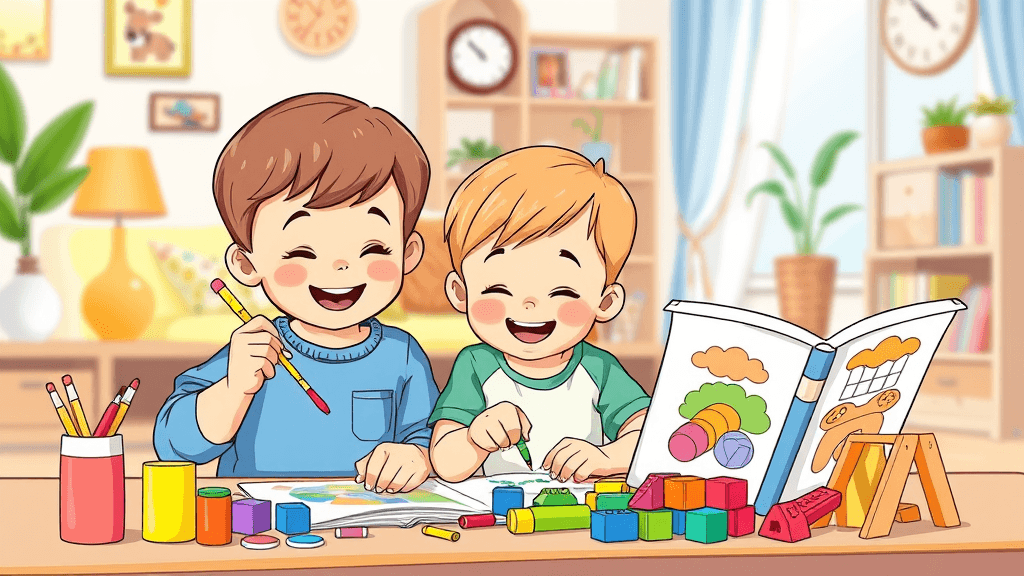
It is 3 pm on a Saturday. Your child has been home from kindergarten since noon, they have already eaten lunch and watched one episode of their favourite show, and they are looking at you with that expression that says "I'm bored." You could hand them the tablet. Or you could do something that is fun AND educational — without it feeling like school.
TL;DR: 15 easy learning activities for K1-K2 kids at home. Covers phonics games, numeracy play, science experiments, and creative projects for Singapore parents.
This guide provides 15 practical activities that build real K1-K2 skills: literacy, numeracy, science thinking, and creativity. Every activity uses materials you already have at home or can get cheaply. No Pinterest-perfect setup required.
Literacy Activities
1. Letter Sound Treasure Hunt
Skills: Phonics, letter-sound recognition, vocabulary
Time: 15-20 minutes
Materials: None
Pick a letter sound (not letter name). Say to your child: "We are going on a /s/ hunt. Let is find everything in the house that starts with /sssss/."
Walk through your home together. Soap. Spoon. Sock. Shoe. Sink. Sofa.
For K2 children, make it harder:
- Find things that END with a specific sound
- Find things with a specific sound in the MIDDLE
- Write down all the words you found and count them
This reinforces synthetic phonics — the same approach used in Singapore kindergartens — in a way that involves movement and exploration rather than sitting at a desk.
2. Story Retelling with Props
Skills: Comprehension, sequencing, oral language, vocabulary
Time: 20-30 minutes
Materials: Any picture book your child knows well, plus household objects as "props"
Read a favourite story together. Then ask your child to retell the story to you (or to a stuffed animal audience) using household items as props. A banana becomes a telephone, a cushion becomes a mountain, a shoe becomes a boat.
This activity builds narrative skills — understanding that stories have a beginning, middle, and end — which is a critical pre-reading skill that many parents overlook.
3. Sight Word Fishing
Skills: Sight word recognition, reading fluency
Time: 15 minutes
Materials: Paper, marker, paper clips, a stick with string and magnet (or just use your fingers)
Write sight words your child is learning on small pieces of paper. Attach a paper clip to each one. Spread them on the floor (the "pond"). Your child "fishes" for a word — when they catch one, they read it aloud. If they read it correctly, they keep it. If not, it goes back in the pond.
Alternatively, skip the fishing setup entirely: just spread word cards face-down and play it as a memory game.
4. Postman / Post Office
Skills: Letter writing, name writing, reading, pretend play
Time: 30 minutes
Materials: Paper, envelopes (or folded paper), crayons
Your child writes "letters" (drawings, scribbles, or real words — any are fine) and "posts" them to family members. Set up a mailbox (any box with a slot cut in the top). Family members write letters back.
For K2 children, encourage them to write simple messages: "I love you Mummy" or "Can we go to the park?" This is authentic writing practice with a purpose — far more motivating than copying sentences from a worksheet.
5. Alphabet Hopscotch
Skills: Letter recognition, letter sounds, gross motor skills
Time: 15 minutes
Materials: Chalk (outdoors) or tape and paper (indoors)
Write letters on the ground in a hopscotch pattern. When your child jumps on a letter, they say its sound (not its name). For K2 children: they say a word that starts with that sound.
This combines phonics practice with physical activity — the combination of movement and learning creates stronger memories than either alone.
Numeracy Activities
6. Grocery Shop Play
Skills: Counting, number recognition, basic addition, money concepts
Time: 30 minutes
Materials: Food items from your pantry, sticky notes for "price tags", play money or real coins
Set up a "shop" with items from your kitchen. Label each with a price (use small numbers: 1, 2, 3, 5). Give your child coins or paper "money." They choose items, count out payment, and you make change.
For K1: Focus on counting coins and matching prices
For K2: Add simple addition ("You want the apple for $2 and the banana for $3. How much altogether?")
This is one of the most effective numeracy activities because it connects numbers to a real-world purpose your child understands.
7. Pattern Necklaces
Skills: Pattern recognition, sequencing, fine motor skills
Time: 20 minutes
Materials: Pasta (penne or rigatoni), string, and paint or markers to colour the pasta
Colour pasta in 2-3 colours. Then string them in patterns: red, blue, red, blue... or red, red, blue, red, red, blue...
Ask your child to identify the pattern, extend it, and create their own. Patterns are a key NEL framework numeracy concept and this activity also builds fine motor skills through threading.
8. Cooking Maths
Skills: Counting, measurement, fractions, following instructions
Time: 30-45 minutes
Materials: Ingredients for a simple recipe (pancakes, cookies, or any family favourite)
Cooking is a goldmine for maths learning:
- "We need 2 eggs. Can you count them?"
- "Pour half a cup of milk."
- "How many cookies are on the tray? If we eat 3, how many are left?"
- "The recipe says 10 minutes. Can you watch the timer?"
Choose a simple recipe and let your child help with every measurable step. The maths is real, purposeful, and delicious.
Science and Discovery Activities
9. Sink or Float Experiment
Skills: Prediction, observation, vocabulary (heavy, light, float, sink)
Time: 20 minutes
Materials: A basin of water, various household objects (coin, leaf, plastic toy, wooden block, paperclip, cork, spoon)
Before testing each object, ask your child: "Do you think it will sink or float?" This is prediction — a fundamental science skill.
Test each object together. Talk about why some float and some sink (weight, shape, material). Keep a simple record: draw two columns ("Float" and "Sink") and let your child draw or write each object in the correct column.
10. Nature Walk Journal
Skills: Observation, vocabulary, drawing, early writing
Time: 30-45 minutes (including the walk)
Materials: A notebook and crayons
Go for a walk around your HDB block, park, or neighbourhood. Ask your child to observe closely:
- "What can you see?"
- "What can you hear?"
- "How does this leaf feel?"
- "What colour is this flower?"
When you return home, your child draws 2-3 things they observed and dictates (or writes) a sentence about each. Over time, this becomes a personal nature journal — a wonderful record of your child's observations and growing literacy.
11. Colour Mixing Exploration
Skills: Observation, prediction, cause and effect, colour vocabulary
Time: 20 minutes
Materials: Red, blue, and yellow paint (or food colouring), water, cups, spoons
Give your child the three primary colours and let them experiment with mixing:
- Red + blue = purple
- Blue + yellow = green
- Red + yellow = orange
Before each mix, ask: "What colour do you think we will get?" This builds prediction skills and provides a memorable hands-on experience with cause and effect.
Creative and Social-Emotional Activities
12. Feelings Charades
Skills: Emotional vocabulary, social-emotional awareness, body language
Time: 15 minutes
Materials: None
Take turns acting out emotions: happy, sad, angry, scared, surprised, excited, frustrated, proud, nervous, shy. The other person guesses the feeling.
Then discuss: "When do you feel [that emotion]? What helps when you feel [that emotion]?"
The NEL framework includes Social and Emotional Development as a core learning area. This game builds emotional vocabulary — the ability to name and understand feelings — which is directly linked to better emotional regulation and fewer behavioural issues.
13. Build and Tell
Skills: Creativity, spatial awareness, narrative skills, vocabulary
Time: 20-30 minutes
Materials: LEGO, blocks, or any construction materials
Give your child a building challenge: "Build a house for a dinosaur." "Build the tallest tower you can." "Build a bridge that a toy car can drive over."
After building, ask them to tell you about their creation: "What is this part? Why did you put that there? What would happen if...?"
This combines spatial-mathematical thinking with oral language skills.
14. Mystery Bag
Skills: Descriptive language, tactile awareness, vocabulary
Time: 10-15 minutes
Materials: A cloth bag (or pillowcase) and 5-6 household objects
Place objects in the bag without your child seeing. They reach in, feel one object (without looking), and describe it: "It is round and smooth and cold." Then they guess what it is before pulling it out.
This builds descriptive vocabulary (rough, smooth, hard, soft, heavy, light, round, flat) — words that are essential for both everyday communication and later academic writing.
15. Digital Learning with QuizKin
Skills: Phonics, sight words, numeracy, Chinese characters, writing practice
Time: 10-15 minutes
Materials: Tablet or phone
Short, focused sessions with QuizKin reinforce the skills your child is practising through hands-on activities. The adaptive algorithm adjusts to your child's level — if they have mastered basic letter sounds, it moves to blending; if number recognition needs work, it provides more practice.
Use QuizKin as the structured component of your home learning routine. Pair it with 1-2 hands-on activities from this list for a balanced learning day that takes less than 30 minutes total.
How to Make a Simple Home Learning Routine
You do not need a complex schedule. A simple daily routine works best:
Weekday routine (after kindergarten):
- 10-15 minutes: Read together (English or Chinese)
- 10 minutes: One activity from this list OR QuizKin practice
- Rest of the afternoon: Free play, outdoor play, family time
Weekend routine:
- Morning: One hands-on activity (20-30 minutes)
- Afternoon: Outdoor play or family outing
- Evening: Read together before bed
School holiday routine:
- Add one extra activity per day from this list
- Keep QuizKin practice going (10 minutes) to maintain skills
- Prioritise experiences: museum visits, cooking, nature walks, library trips — browse family activities on Klook for discounted attraction tickets
The 80/20 Rule
Eighty percent of your child's learning at home should happen through play, conversation, and everyday experiences — not formal instruction. The 20 percent of structured practice (reading, phonics drills, app-based learning) is most effective when it is short, focused, and consistent.
A child who reads with a parent for 15 minutes every day, plays creatively for an hour, and does 10 minutes of structured practice will outperform a child who does an hour of worksheets followed by passive screen time. Quality and consistency beat quantity every time.
Summary
The best home learning activities for preschoolers are the ones that do not feel like school. They are games, explorations, conversations, and creative projects that happen to build literacy, numeracy, and thinking skills. Keep activities short, follow your child's interests, and do not worry about covering everything. Fifteen minutes of engaged, joyful learning every day is worth more than an hour of reluctant drilling. Your child's curiosity is their greatest learning asset — your job is to feed it.
Sources
- Nurturing Early Learners (NEL) Framework — Ministry of Education, Singapore
- The Power of Play: A Research Summary — Yogman et al., American Academy of Pediatrics, 2018
- Learning Through Play — UNICEF & LEGO Foundation, 2018
Looking for more? Check out find a tutor for free on TuitionLah.
Exploring parenthood in Singapore? Visit ParentLah for practical tips on raising kids in Singapore.
Practise what you've read with QuizKin
Adaptive quizzes covering phonics, sight words, numbers, and more — aligned with the Singapore MOE curriculum. Free for one child.
Frequently Asked Questions
For K1-K2 children (ages 4-6), aim for 30 to 45 minutes of structured learning activities at home per day, broken into two or three short sessions. This includes reading practice, phonics or numeracy activities, and any educational app time. The rest of their home time should be free play, outdoor play, and family interaction. Children this age learn through play — structured and unstructured time are both valuable.
This usually means the activities feel too much like school or homework. The solution is to embed learning into play so your child does not realise they are practising skills. Count steps while walking. Spot letters on signs. Sort laundry by colour. Read stories as part of bedtime routine. When learning is woven into everyday activities, resistance typically disappears.
Worksheets have a limited role. They can be useful for short, focused practice (5-10 minutes of letter or number writing), but they should not be the primary learning method for preschoolers. Children aged 4-6 learn more effectively through hands-on, multi-sensory activities — manipulating objects, playing games, creating art, and exploring their environment. Over-reliance on worksheets can create resistance to learning.
School holidays are an opportunity for unstructured learning through experience. Visit museums, parks, and nature reserves. Cook together. Do art and craft projects. Read more books than usual. Maintain a small amount of daily practice (10-15 minutes of reading or phonics through an app like QuizKin) to prevent skills from regressing, but prioritise experiences over academics during breaks.
A good daily balance for preschoolers is 30-45 minutes of structured learning activities (mix of hands-on and digital), 15-30 minutes of quality screen time (educational apps, not passive video), at least 60 minutes of physical activity (outdoor play, sports), and plenty of unstructured free play. The key is that screen time supplements rather than replaces hands-on activities. Apps like QuizKin work best as a complement to reading, crafts, and physical play.
Ready to make learning fun?
QuizKin turns screen time into learning time with adaptive quizzes built for K1-K2 kids in Singapore. Free to start.
Related Articles
Enrichment Classes vs Home Learning: What Works for K1-K2 Kids
Should you send your K1-K2 child for enrichment classes? Compare costs, effectiveness, and alternatives. A practical guide for Singapore parents on a budget.
My Child Is Not Reading Yet: A Singapore Parent's Guide (K1-K2)
Your K1 or K2 child is not reading while classmates are. When to worry, when to wait, and practical steps to support a late or reluctant reader in Singapore.
Speech & Language Development in Preschoolers (Singapore Guide)
Is your child's speech on track? Age-by-age milestones for 3-6 year olds, signs of delay, when to see a therapist, and how to support language at home.