Montessori vs Structured Learning in Singapore: Which Preschool Approach Is Right?
Montessori or structured preschool? Compare both approaches for Singapore K1-K2 children — curriculum, cost, P1 readiness, and how to decide based on your child's temperament.
QuizKin Team
Published 29 April 2026
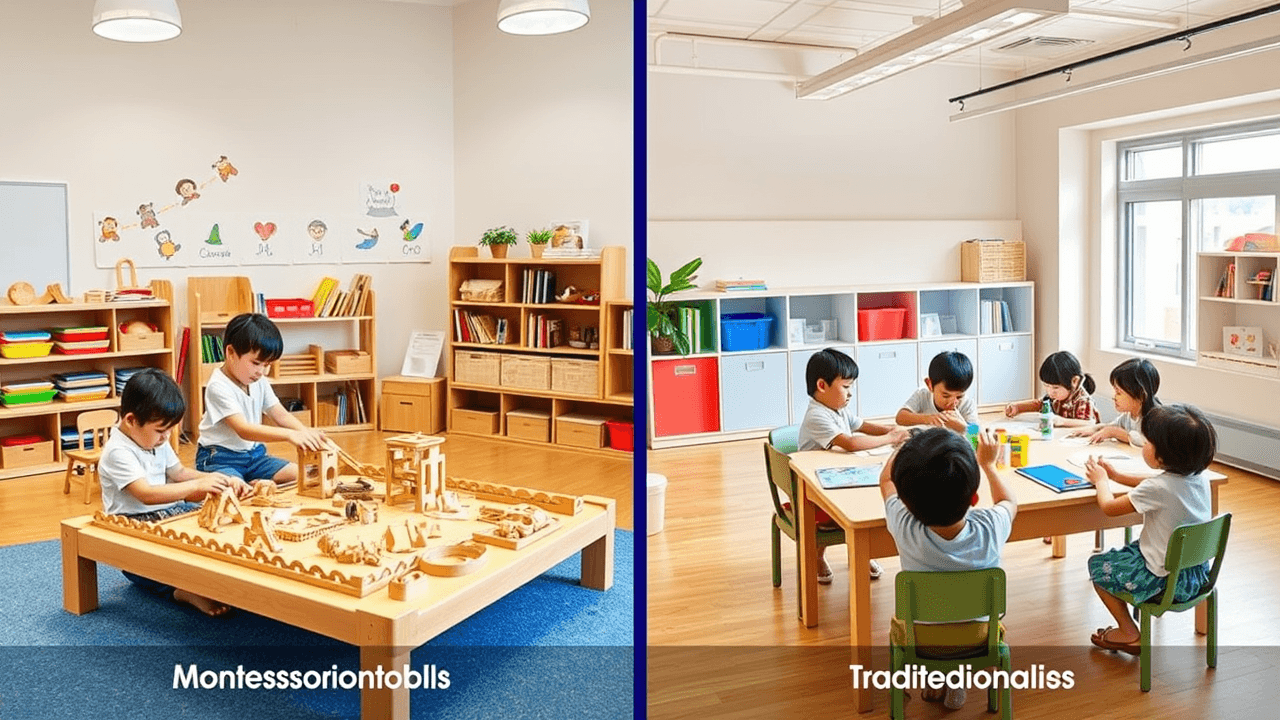
You are choosing a kindergarten for your child, and the biggest question is not which specific school — it is which approach. Montessori? Structured? Play-based? Reggio Emilia? The labels multiply and the marketing gets louder, but the core decision most Singapore parents face is this: do you want your child in an environment that emphasises self-directed exploration (Montessori), or one that follows a more teacher-led, curriculum-driven structure?
TL;DR: Montessori or structured preschool? Compare both approaches for Singapore K1-K2 children — curriculum, cost, P1 readiness, and how to decide based on your child's temperament.
This guide breaks down both approaches honestly. No ideology, no agenda — just a clear comparison so you can match the right approach to your child and your family's priorities.
What Is Montessori Learning?
Montessori education was developed by Dr. Maria Montessori in Rome in 1907. It is based on the idea that children learn best when they choose their own activities within a prepared environment. Key principles include:
Child-led learning: Children select their own work from a range of activities available on open shelves. A K1 child might choose to practise pouring water, then move to letter tracing, then work on a puzzle — all within the same morning. The teacher observes and guides rather than directing.
Mixed-age classrooms: Most Montessori preschools group children across a 3-year age range (typically 3 to 6 years). Younger children learn from older ones, and older children reinforce their knowledge by helping younger peers.
Hands-on materials: Montessori classrooms use specially designed materials — sandpaper letters for tracing, bead chains for counting, pink tower blocks for understanding size gradation. These materials make abstract concepts concrete and tactile.
Uninterrupted work periods: Children are given long blocks of uninterrupted time (typically 2 to 3 hours) to engage deeply with their chosen activities. Interruptions and transitions are minimised.
Practical life skills: Pouring, sweeping, buttoning, folding — these everyday tasks are treated as legitimate learning activities that build concentration, fine motor skills, and independence.
What Is Structured Learning?
Structured learning — sometimes called "traditional" or "academic" preschool — follows a teacher-directed curriculum with defined learning objectives, timetabled activities, and group instruction. Key features include:
Teacher-directed lessons: The teacher plans and leads activities. All children in the class work on the same topic at the same time — today is letter B, tomorrow is letter C.
Same-age classrooms: Children are grouped by age. All K1 children are together, all K2 children are together. Activities are designed for a specific developmental level.
Timetabled schedule: The day follows a predictable structure — circle time, phonics lesson, snack, outdoor play, writing practice, Chinese lesson, story time. Children know what comes next.
Workbooks and worksheets: Structured preschools typically use more paper-based activities. Children practise letter formation in workbooks, complete colouring and tracing worksheets, and work through structured exercises.
Assessment and benchmarks: Progress is measured against defined milestones. Parents receive regular reports showing where their child stands relative to curriculum expectations.
Head-to-Head Comparison for Singapore Parents
Curriculum and Academic Preparation
Montessori: Academic skills are embedded within the environment rather than explicitly taught. Children learn letters through sandpaper tracing and moveable alphabets. They learn numbers through bead frames and stamp games. The pace depends on the individual child — a 4-year-old who is ready for reading will be supported in reading, while a classmate who is not ready will not be pushed. All licensed Montessori preschools in Singapore must align with the MOE NEL framework, so the six learning areas are covered, but the delivery looks different from a structured classroom.
Structured: Academic content is delivered explicitly and sequentially. Phonics is taught in a defined order (often Jolly Phonics or Letterland). Chinese characters are introduced systematically with specific word lists. Maths follows a progression from counting to simple addition. Parents can see exactly where their child is in the curriculum at any time. This transparency is reassuring for parents who want to track progress.
Bottom line: Both cover the same academic ground by the end of K2. Structured preschools tend to get there earlier and more visibly. Montessori preschools may appear to be "behind" in the middle of K1 but typically catch up by late K2 — and sometimes surpass structured peers in depth of understanding because they learned through exploration rather than memorisation.
Primary 1 Readiness
This is the question that keeps Singapore parents awake at night. Will my child cope in Primary 1?
Montessori: Children from Montessori preschools sometimes experience an adjustment period in Primary 1 because the format is different — sitting at desks, following a teacher's instructions, working within a fixed timetable. However, Montessori children often bring strong concentration skills, self-regulation, and intrinsic motivation that serve them well once they adjust. Research from Singapore's National Institute of Education suggests that any adjustment gap typically closes by Primary 2.
Structured: Children from structured preschools are already familiar with the classroom format they will encounter in Primary 1 — timetables, worksheets, teacher-directed lessons, and sitting at a desk for extended periods. The transition tends to be smoother initially because the environment feels familiar.
Bottom line: Structured preschools produce smoother P1 transitions. Montessori preschools produce children who may take a few weeks longer to adjust but often develop deeper self-regulation. Neither approach produces a meaningful long-term advantage by Primary 2. If P1 readiness is your top priority and you are anxious about the transition, a structured preschool will give you more peace of mind.
Social and Emotional Development
Montessori: The mixed-age classroom is Montessori's strongest social-emotional feature. Five-year-olds who help three-year-olds develop empathy, patience, and leadership. Three-year-olds who look up to five-year-olds develop aspiration and social confidence. The emphasis on "grace and courtesy" — how to interrupt politely, how to wait for a turn, how to resolve conflicts verbally — is built into daily practice rather than taught through worksheets.
Structured: Social-emotional learning in structured preschools happens through group activities, collaborative projects, and explicit social skills lessons. Children learn to take turns during circle time, share materials during art, and work in teams during group projects. The same-age grouping means children interact with peers at similar developmental levels, which some children find more comfortable.
Bottom line: Montessori has an edge in developing independence, empathy, and cross-age social skills. Structured preschools have an edge in building same-age peer collaboration and following group norms. Both produce socially capable children.
Cost in Singapore
MOE Kindergarten (structured, government): S$160/month for Singapore Citizens, S$320 for PRs. The most affordable option, but waitlists can be long.
Anchor operators — PCF Sparkletots, My First Skool (structured, subsidised): S$300 to S$700/month after subsidies. Good quality, widely available, and affordable.
Private structured preschools: S$800 to S$1,800/month. Brands like MindChamps, EtonHouse (non-Montessori programmes), and Busy Bees fall here.
Private Montessori preschools: S$1,000 to S$2,500/month. Premium brands like Brighton Montessori, Modern Montessori, and Raffles Kidz charge at the higher end. Note that "Montessori" is not a trademarked term — any centre can use the name regardless of adherence to Montessori principles. Always verify the school's AMI (Association Montessori Internationale) or AMS (American Montessori Society) credentials.
Bottom line: Montessori is generally more expensive, but the gap narrows when comparing private structured vs. private Montessori centres. MOE Kindergarten remains unbeatable on value if your primary concern is cost.
Daily Experience — What Your Child Actually Does
A typical morning in a Montessori K1 class:
8:00 — Arrival. Child hangs up own bag, changes shoes, selects first activity from the shelf.
8:15 — Uninterrupted work period begins. One child traces sandpaper letters. Another pours rice between jugs. A third works on a number puzzle with a teacher guiding.
10:00 — Snack. Children prepare their own snack (pouring water, peeling fruit) and clean up after themselves.
10:30 — Group circle time. Story, song, or short lesson.
11:00 — Outdoor play.
11:30 — Second work period or small-group activity (art, Chinese, music).
12:30 — Lunch and rest.
A typical morning in a structured K1 class:
8:00 — Arrival. Morning greetings, attendance.
8:15 — Circle time. Calendar, weather, theme introduction.
8:45 — Phonics lesson (whole class). Letter of the week, sound practice.
9:15 — Worksheet or workbook activity (letter formation, colouring).
9:45 — Snack (teacher-served).
10:00 — Chinese lesson (teacher-led).
10:30 — Outdoor play.
11:00 — Maths activity (counting, sorting, patterns).
11:30 — Art or music.
12:00 — Story time.
12:30 — Lunch and rest.
Notice the difference in structure density. Montessori has fewer transitions and longer free-work blocks. Structured has more variety and more teacher-directed activities. Neither is inherently superior — it depends on your child.
Which Approach Suits Which Child?
This is the question that matters most, and it depends on your child's temperament, not on educational philosophy.
Your child may thrive in Montessori if they:
- Are naturally curious and self-motivated
- Can focus on a task for extended periods when interested
- Are independent and prefer to do things themselves
- Are introverted or prefer working alone or in small groups
- Get frustrated when told exactly what to do and when
- Learn best through hands-on exploration rather than instruction
Your child may thrive in structured learning if they:
- Enjoy routines and predictability
- Are sociable and energetic, thriving in group activities
- Need external structure to stay focused (get distracted easily when left to self-direct)
- Respond well to clear instructions and expectations
- Enjoy the sense of completion from finishing worksheets or workbooks
- Are anxious in unstructured environments and prefer knowing what comes next
Many children fall somewhere in between — and that is where Singapore's growing number of hybrid preschools come in. Centres like EtonHouse, Raffles Kidz, and some newer operators blend Montessori principles (child choice, practical life, hands-on materials) with structured elements (timetabled group lessons, explicit phonics instruction, Chinese curriculum). If your child does not fit neatly into either camp, a hybrid programme may be the best fit.
The Singapore Reality: It Is Not Purely One or the Other
The Montessori vs structured debate sounds like a binary choice, but in practice, most Singapore preschools sit on a spectrum.
"Montessori" centres that are partly structured: Many Singapore Montessori preschools add teacher-led phonics, Chinese, and maths lessons on top of the Montessori work period. They know parents expect visible academic progress and P1 readiness, so they layer structured content into a Montessori-inspired environment.
"Structured" centres that use Montessori elements: Some structured preschools incorporate Montessori practical life activities, child-choice periods, or hands-on materials into an otherwise timetabled day. The influence of Montessori has spread beyond pure Montessori schools.
MOE Kindergarten's middle ground: MOE Kindergarten follows a structured play-based approach that borrows from multiple philosophies. It is neither pure Montessori nor pure academic drilling. The curriculum is built around purposeful play, inquiry, and structured activities — a pragmatic blend that reflects Singapore's educational philosophy.
When visiting schools, focus less on labels and more on these observable factors:
- How much choice does your child have during the day?
- How do teachers respond when a child is disengaged or struggling?
- What is the ratio of teacher-directed to child-directed time?
- How is academic content (phonics, Chinese, maths) delivered?
- What does the classroom environment look and feel like?
What You Can Do at Home Regardless of School Choice
Whichever preschool approach you choose, home learning is where you can fill gaps and reinforce strengths.
If your child is in Montessori and you want more academic structure:
- Use educational apps like QuizKin for structured phonics practice and Chinese character writing
- Set up a short daily learning routine at home — 15 minutes of guided practice covers a lot of ground
- Read decodable books together to reinforce phonics skills your child is developing at school
If your child is in a structured preschool and you want more independence:
- Create a Montessori-inspired space at home with child-accessible shelves, art materials, and practical life activities
- Let your child choose what they want to learn about during free time — follow their interests
- Resist the urge to over-schedule enrichment classes. Unstructured play time is when children develop creativity, problem-solving, and self-direction
Key Takeaways
- There is no universally "better" approach. Montessori and structured learning both produce capable, happy children when implemented well. The right choice depends on your child's temperament and your family's priorities.
- P1 transition concerns are overblown. Children from both approaches adjust to Primary 1. Structured preschool children adjust faster initially; Montessori children catch up quickly. By Primary 2, the difference is negligible.
- Cost is a real factor. Montessori tends to be pricier. MOE Kindergarten offers excellent structured education at S$160/month. Factor cost into your decision honestly — an expensive Montessori preschool is not automatically better than an affordable structured one.
- Visit schools during class time. Websites and brochures sell a philosophy. A classroom visit during a normal school day shows you reality. Watch how teachers interact with children, especially the ones who are struggling or disengaged.
- Labels are less important than quality. A mediocre Montessori preschool is worse than an excellent structured one, and vice versa. Focus on teacher quality, environment, and whether your child feels happy and safe.
- Home learning fills the gaps. Phonics apps, reading routines, and daily practice at home complement any preschool approach. Do not rely on school alone.
- Most Singapore preschools are hybrids anyway. Pure Montessori and pure structured programmes are rare. Most centres blend elements of both. Focus on the specific balance a school offers rather than its label.
Sources
- ECDA — Early Childhood Development Agency
- MOE — Preschool Education
- MOE — Nurturing Early Learners Framework
Looking for more? Check out find a tutor for free on TuitionLah.
Exploring parenthood in Singapore? Visit ParentLah for practical tips on raising kids in Singapore.
Practise what you've read with QuizKin
Adaptive quizzes covering phonics, sight words, numbers, and more — aligned with the Singapore MOE curriculum. Free for one child.
Frequently Asked Questions
Both approaches can prepare children well for Primary 1, but they do so differently. Structured preschools directly rehearse P1-style skills like sitting at a desk, following teacher instructions, and completing worksheets within a time frame. Montessori preschools build underlying skills like concentration, independence, and self-regulation that support academic learning. Research from Singapore's National Institute of Education suggests that children from quality preschools of any approach perform similarly by Primary 2 — the initial adjustment difference in Primary 1 tends to disappear quickly.
Private Montessori preschools in Singapore typically cost S$1,000 to S$2,000 or more per month for a full-day programme. Private structured preschools range from S$800 to S$1,800 per month. MOE Kindergarten, which follows a structured play-based curriculum, costs S$160 per month for Singapore Citizens and S$320 for Permanent Residents. Anchor operators like My First Skool and PCF Sparkletots offer subsidised rates. The cost gap between Montessori and structured has narrowed in recent years as more centres offer hybrid approaches.
Highly active children often do well in either setting, but the experience differs. In a Montessori classroom, active children have freedom to move between activities, which channels their energy productively. However, they must still learn to work quietly and independently, which some energetic children find challenging. In a structured classroom, active children benefit from clear routines and group activities, but may struggle with extended seated work. Visit both types of preschools during class time and observe how teachers manage active children before deciding.
Yes, and many Singapore parents do this naturally. You can apply Montessori principles at home — child-accessible shelves, practical life activities like pouring and folding, and free choice of activities — while also providing structured learning time using workbooks, educational apps like QuizKin, or guided reading sessions. This blended approach gives your child the benefits of independence and self-direction alongside the academic structure that prepares them for formal schooling.
Yes. Most licensed preschools in Singapore, including Montessori centres, must align with the Ministry of Education's Nurturing Early Learners (NEL) framework. This means even Montessori preschools cover the six NEL learning areas: aesthetics and creative expression, discovery of the world, language and literacy, motor skills development, numeracy, and social and emotional development. The difference is in how they deliver these outcomes — Montessori centres use child-led exploration while structured centres use teacher-directed lessons. Always ask a prospective preschool how they incorporate NEL standards.
Ready to make learning fun?
QuizKin turns screen time into learning time with adaptive quizzes built for K1-K2 kids in Singapore. Free to start.
Related Articles
How to Choose a Kindergarten in Singapore (2026)
Compare MOE Kindergarten, PCF, NTUC, and private preschools in Singapore. Fees, curriculum, teacher quality, and what to look for during kindergarten visits.
Bilingual Learning for Preschoolers: English & Mother Tongue (Singapore)
Raise a bilingual child in Singapore. Strategies for balancing English and Mother Tongue at home, common myths debunked, and daily routines for K1-K2 kids.

Teach Your Child to Read at Home (Singapore Guide)
Help your K1-K2 child read independently at home. From phonics and sight words to building fluency, aligned with the Singapore MOE kindergarten curriculum.